


“An accomplished author, musician, artist and sculptor, Mrs. Ella May Walker, of 11103 Saskatchewan Drive, died Wednesday afternoon after a long illness.” So read the Edmonton Journal on April 7, 1960, a day after Ella May Walker passed away following a 2 year battle with cancer.
Though her life was at an end, her legacy had just begun. She touched the lives of many Edmontonians and her contributions would help shape the future of the city. Her pioneering role in preserving Edmonton’s heritage was recognized in 1975 when she was among the first winners of the Edmonton Historical Board Recognition Award.
Ella May Walker Memorial Award
The Ella May Walker Memorial Award is presented to students in the Residential Interiors Certificate Program at the University of Alberta’s Faculty of Extension.
The award was made possible by a donation from Wilfrid and Jim Walker, Ella’s 2 sons.
The award is a fitting legacy to their mother, who was so active in the local art scene, serving as president of the Edmonton Chapter of the Alberta Society of Artists and as vice-president of the Edmonton Art Club. She was also active in campus life, teaching sculpture and painting through the U of A Faculty of Extension and as a member of the Faculty Women’s Club.
City of Edmonton Historic Resources Program
One of Ella May Walker's most lasting contributions to Edmonton was her efforts to preserve local historic sites. In its role of advising the Council, the Archives and Landmarks Committee (renamed the Edmonton Historical Board in 1966) has done its best to continue her fight.
Without the legal means to protect historic places, conservation efforts by Ella and other like-minded people could only go so far. Therefore, in 1971, the Edmonton Historical Board suggested Council restrict the alteration or demolition of historic buildings.
In 1975, the Edmonton Historical Board created the Heritage Sites Selection Committee (now the Heritage Resource Review Panel) to assess buildings and sites for preservation, and to evaluate them for heritage value. This was a task that was first done by Ella in the 1940s. To deal with the historic sites, the City’s Planning Department hired their first Heritage Officer in 1981.
Today, the City of Edmonton Historic Resources Program administers over 100 designated heritage buildings and several hundred that have been identified as historically significant by the Edmonton Historical Board.
John Walter Museum
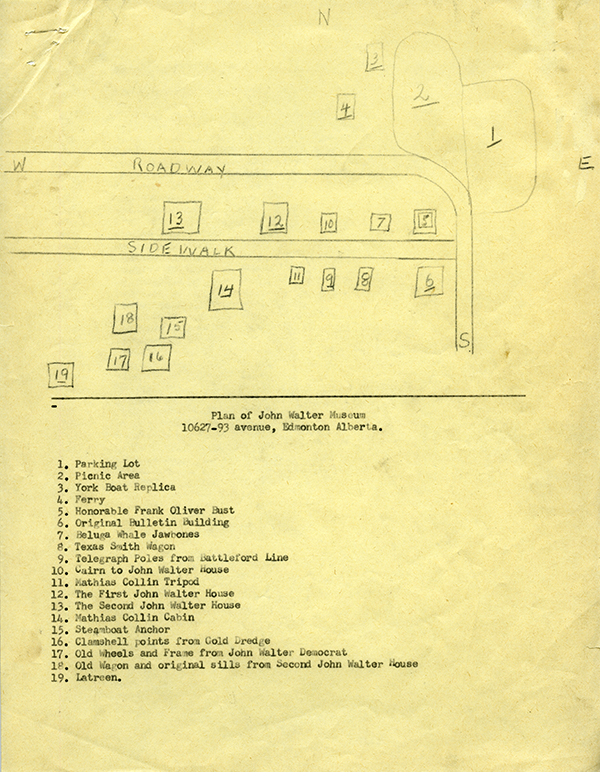
The 1875, John Walter house was among the first historic buildings identified by Ella May Walker and the Archives and Landmarks Committee. In January 1953, the Committee asked the City Commissioners to restore the Walter house. Although Ella May Walker retired from the committee in July of that year, the project continued.
By 1959 the house was open to the public, and in 1960, the Edmonton Bulletin Building was moved to the site. Today, this building is now in Fort Edmonton Park.
Two years later, restoration began on the 1886 House, and in 1974, the third Walter House, dating from 1901, was moved from its original location near the High Level Bridge and placed on a concrete foundation near the two other homes.
Today, the John Walter Museum is operated by the City of Edmonton and is home to school programs, workshops, and other special events.
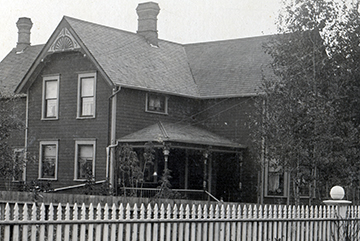
EA-102-389
Fort Edmonton Park
Fort Edmonton Park is located in Edmonton's scenic river valley just west of the Quesnell Bridge. It is one of Canada's largest open air, living history museums and welcomes tens of thousands of visitors every year. Although it is now an Edmonton institution, it was a long road to make Fort Edmonton Park a reality.
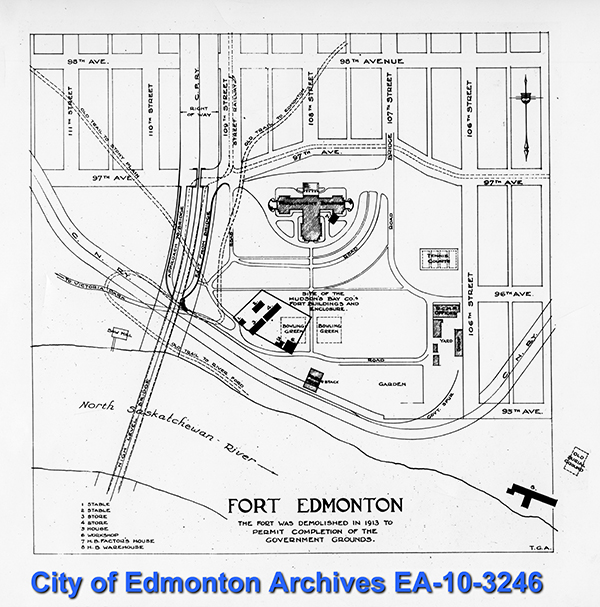
As early as 1949, the Archives and Landmarks Committee recommended the reconstruction of Fort Edmonton, which had been dismantled in 1915. Discussions about the idea continued for many years. Many potential sites were suggested, including the south lawn of the Legislature (the original location) and west of the Royal Glenora Club in Victoria Park.
The Committee made little progress until 1962, when they suggested the Fort be made a Centennial Project to mark Canada's hundredth birthday in 1967. The City bought the land and Fort Edmonton Park was officially dedicated on July 9, 1967.
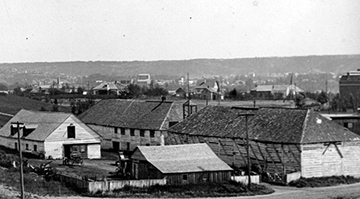
[EA-102-942]
Historic Resources Photo Gallery
![John Walter and family 1888 [EA-10-1677]](/sites/default/files/public-files/images/caemw_ea101677_600w336h.jpg)
![Walter House 1914 [EA-10-2170]](/sites/default/files/public-files/images/caemw_ea102170_600w397h.jpg)

![John Walter Museum in 1966 [EA-10-2199]](/sites/default/files/public-files/images/caemw_ea102199_600w383h.jpg)
![John Walter Museum 1971 [ET-18-2676]](/sites/default/files/public-files/images/caemw_et182676_600w.jpg)
![John Walter Museum 1971 [ET-18-2698]](/sites/default/files/public-files/images/caemw_et182698_600w.jpg)
Beginning in the 1930s, the Archives Committee (later the Archives and Landmarks Committee) began collecting historical items for display: photographs of early Edmonton, documentary evidence of Fort Edmonton, information on land grants, and the histories of the early churches. As material was donated or purchased, the archives were stored in the Public Library and the artifacts were displayed in Civic Block.
As a result of continued requests for a proper museum from the Committee, the City created the Historical Exhibits Building (formerly the City Telephones Stores Building) at 10105–112 Avenue.
When the Archives and Landmarks Committee became the Edmonton Historical Board in 1966, the Historical Exhibits Building, John Walter Museum, and future developments, such as Fort Edmonton Park, became the City's responsibility.
In 1971, City Council created the City of Edmonton Archives. In 1973, the artifacts were removed from the Historical Exhibits Building, allowing for the space to be dedicated entirely to Edmonton's documentary heritage. In 1993, the Archives opened in its new location at the historic Prince of Wales Armouries.
The artifacts became the nucleus for the collection at John Walter Museum and Fort Edmonton, where they were housed at the Cromdale Bus Barns until 1974. The artifacts were later moved to the old O’Keefe Brewery, known today as the City of Edmonton Artifact Centre.
Gallery
![Edmonton Historical Exhibit layout [RG-11 o/s 3.3 File 14]](/sites/default/files/public-files/images/caemw_rg11os33file14_600w419h.jpg)
![City Archives 1977 [EA-266-102]](/sites/default/files/public-files/assets/city_archives/caemw_ea266102_430w.jpg)
![Interior - Historical Exhibits Building 1960 [EA-10-3139a]](/sites/default/files/public-files/images/caemw_ea103139a_600w474h.jpg)
![Historical Exhibits Building [EA-10-1045]](/sites/default/files/public-files/images/caemw_ea101045_600w.jpg)
![City Archives Reference Room [EA-160-1865]](/sites/default/files/public-files/images/caemw_ea1601865_600w402h.jpg)
Contact Us
City of Edmonton Archives
Prince of Wales Armouries, 2nd floor
10440 108 Avenue
Edmonton, Alberta
Email cms.archives@edmonton.ca