


Heritage Conservation is defined by the Canadian Encyclopaedia as “the identification, protection and promotion of things that are important to our culture and history.”
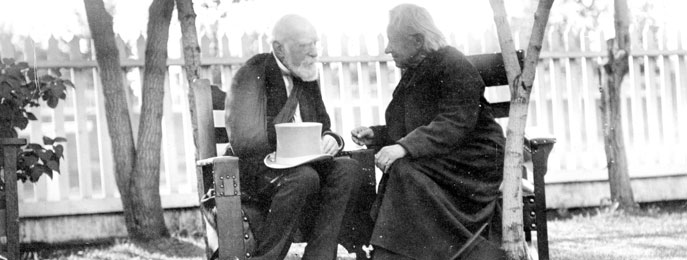
[EA-10-1660]
Lord Stathcona and Father Albert Lacombe meeting amidst young maple trees in Hardisty’s garden in 1909.
Ella May Walker was one of Edmonton's pioneers in heritage conservation and in the language of the day, she was a preservationist. She served on the Archives and Landmarks Committee from its creation in 1947 until 1953.
The Committee Is Created
The Archives and Landmarks Committee was first proposed in 1938. Edmonton's Public Librarian, H. C. Gourlay was appointed archivist, and the collection of historic material began.
Ella May Walker served on the Archives and Landmarks Committee from its creation in 1947 until 1953.
Despite its early beginning, little happened until 1947 when Bylaw 1121 was passed, which established the Archives and Landmarks Committee.
Bylaw 1121
[MS 52 Item 19]
1948 Annual Report
[RG21-A92-6]
Goals:
- To identify places of historical interest in the city
- To identify sources from which historical materials could be obtained;
- To record current events which may become of interest in the future
- To create and maintain public interest in the objects of the Committee.
Ella May Walker's Role
Ella was primarily involved in the first and last goals: identifying places of historical interest in the city, and maintaining public interest in the objects of the Committee.
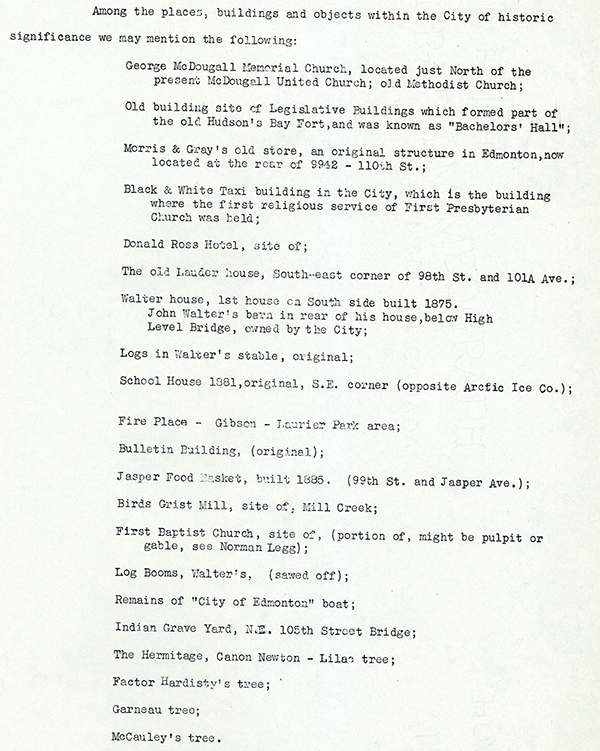
Through her work on "Fortress North", she identified a number of historic places, buildings and objects in Edmonton.
It was recommended that those places should be preserved if possible, and that all should receive historical markers.
The sites identified by the committee were all pre-1900, with particular emphasis on resources associated with early prominent Edmontonians and early institutions, highlighting the public’s fascination with their pioneer-era forbearers after the Second World War.
![Archives & Landmarks Committee 1949 [EA-10-2369]](/sites/default/files/public-files/images/caemw-ea102369-600w480h.jpg)
![Edmonton Public Library [EA-10-740]](/sites/default/files/public-files/images/caemw_EA10740_600w497h.jpg)
![Page 1 of Bylaw 1121 [MS-52 Item 19]](/sites/default/files/public-files/images/caemw_MS52Item19Bylaw1121p1_600w791h.jpg)
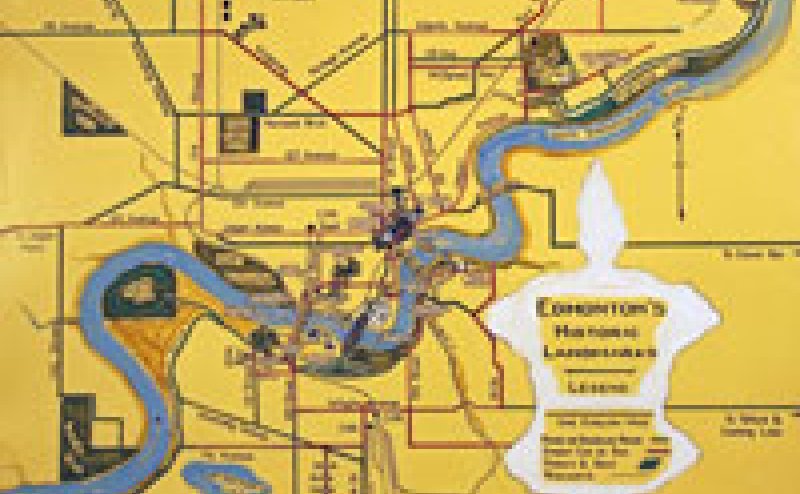
![Map of 18 heritage sites, by Ella May Walker, 1947 [EA-1-15]](/sites/default/files/public-files/images/caewm_eaa115_600w.jpg)
![1949 printing of Ella May Walker's map [MS-583]](/sites/default/files/public-files/images/caemw_MS583_600w387h.jpg)
![Low Level Bridge 1902 [EA-10-340]](/sites/default/files/public-files/images/caemw_ea10340_600w.jpg)
![McDougall Methodist Church 1892 [EA-10-383]](/sites/default/files/public-files/images/caemw_ea10383_600w.jpg)
![Muchias' House 1948 [EA-10-675]](/sites/default/files/public-files/images/caemw_ea10675_600w.jpg)
![Bulletin Building 1935 [EA-10-3266]](/sites/default/files/public-files/images/caemw_ea103266_600w.jpg)
![Bulletin Building move in 1974 [ET-18-2586]](/sites/default/files/public-files/images/caemw_et182586_600w.jpg)
Stevenson's Cabin
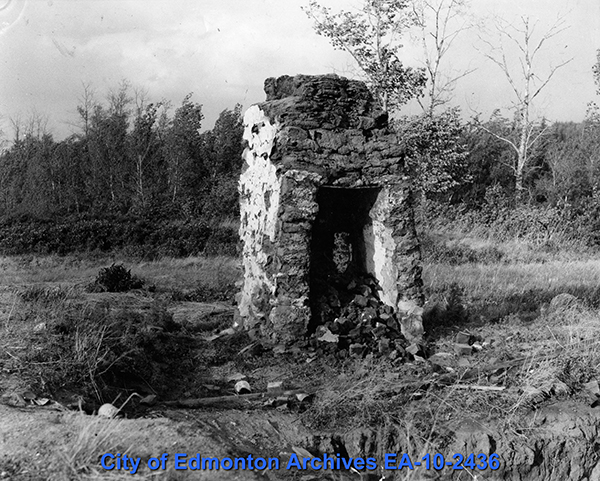
Stevenson's Cabin was one of the earliest conservation projects undertaken by the Committee related to Charles "English Charlie" Stevenson.
English Charlie was one of Edmonton's earliest and most colourful characters. He was said to be a London news-boy who came to the new world as a stow-away. He arrived in Edmonton in the 1870s, where he travelled the continent panning for gold. Charles built a cabin in present day Laurier Park, known in those days as Miner's Flats.
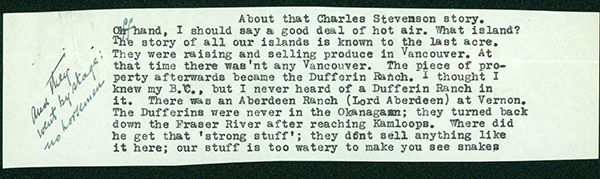
Sketch of the Life of Charles Stevenson by S.H. Smith
[Stevenson clipping file]
Stevenson secured homestead rights to the land around 1903, and soon after sold the land to realtor S. H. Smith for $12 an acre.
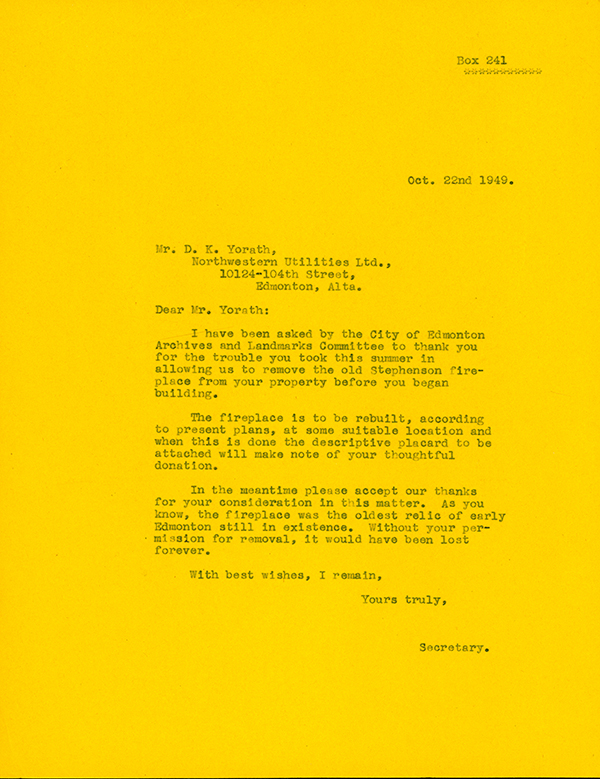
By 1948, another prominent Edmontonian had purchased the land: D.K. Yorath. He was planning to build a house on the site and therefore donated the chimney to the Archives and Landmarks Committee. Plans were made to rebuild the structure either near the John Walter House or at a reconstruction of Fort Edmonton.
Despite the best intentions, the mud and straw mortar used in the chimney was too fragile for the move, and the plans for its re-erection were abandoned.
Donald Ross Edmonton Hotel
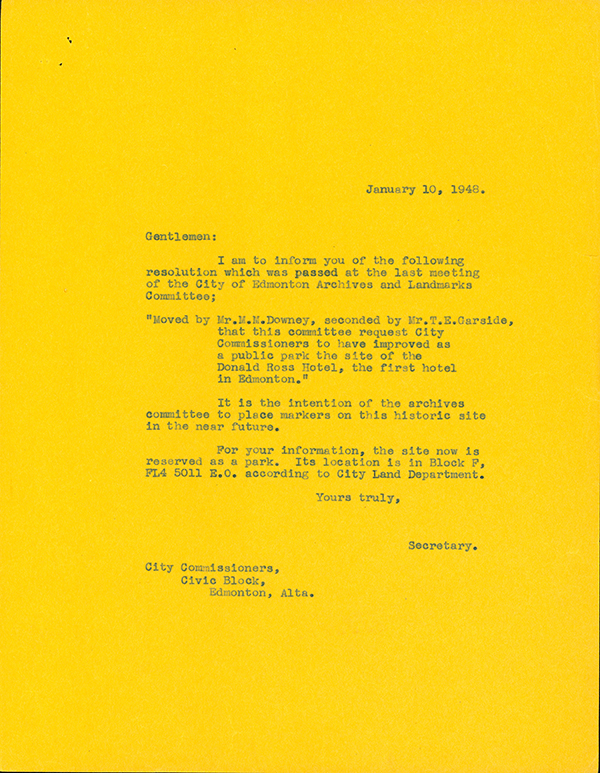
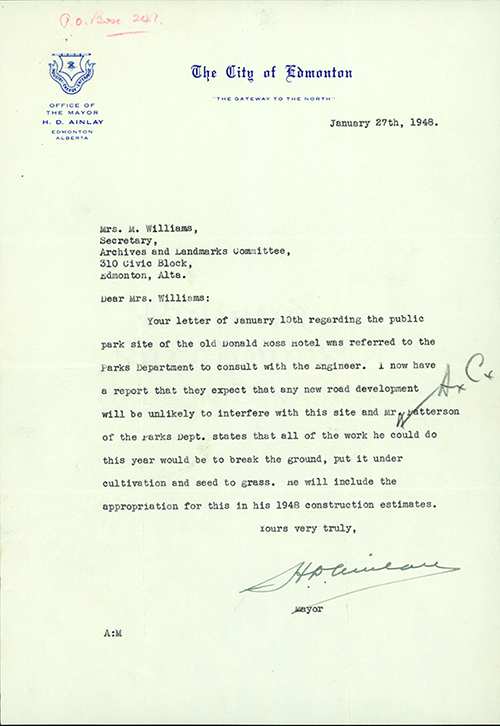
The Committee also made suggestions to Council on how to preserve historic sites, as was the case with the site of Donald Ross Edmonton Hotel.
Donald Ross arrived in Edmonton in 1872 and purchased 70 acres of land near present-day Rossdale. Here, he built one of the community's first houses. Ross rented the second floor of his house to newly arrived settlers, creating Edmonton's first hotel. As more people came to Edmonton, Ross needed more space and expanded the home 3 times. When he died in 1915, the Edmonton Hotel was turned into a rooming house.
Unfortunately, it later burned down in 1925.
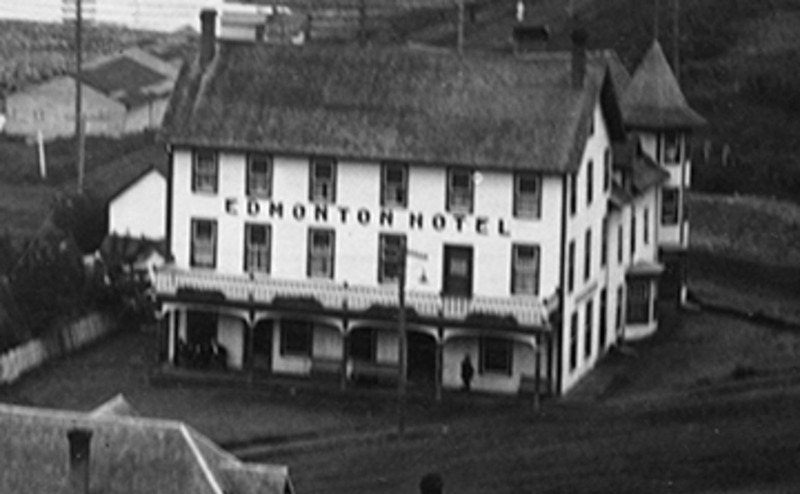
[EA-25-18]
1881 School House
Ella May Walker identified the 1881 School House as an important historical building, and it appears on her map of Edmonton's Historic Landmarks. Built in 1881, the building was Edmonton's first public school. It was used until 1904, when MacKay Avenue School was built. Eventually the small school was sold and moved to Rossdale, where it became a private residence. Although some changes were made, Ella's interest kept the building on the Committee's radar. In 1979, it was purchased by the City of Edmonton and donated to the Edmonton Public School Board (EPSB). It was moved to its current location very near its original site and restored as part of the EPSB Centennial in 1982.
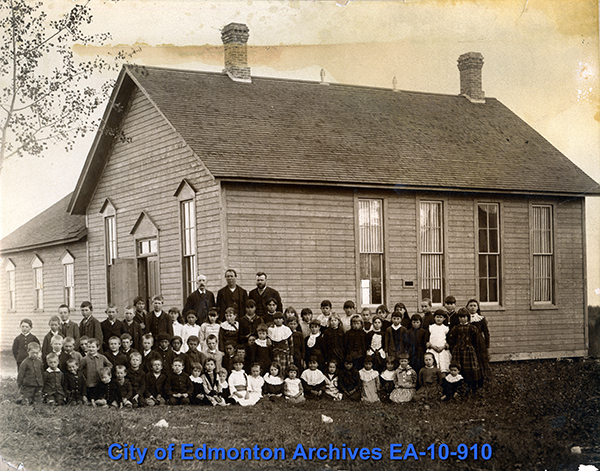
Conservation Projects Photo Gallery
![Charles “English Charlie” Stevenson in 1904. [EA-10-669-92]](/sites/default/files/public-files/images/caemw_EA1066992_500w701h.jpg)
![[EA-10-2594]](/sites/default/files/public-files/images/caemw_ea102594_600w.jpg)
![Stevenson's cabin which burned down around 1946 [EA-10-2436]](/sites/default/files/public-files/images/caemw_EA102436_600w481h.jpg)
![Flood of 1915 [EA-25-18]](/sites/default/files/public-files/images/caemw_ea2518_600w.jpg)
![Ross Hotel replica fireplace 1961 [EA-4-26]](/sites/default/files/public-files/images/caemw_ea426_600w.jpg)
![Ross Hotel commemorative plaque [EA-4-27]](/sites/default/files/public-files/images/caemw_ea427_600w.jpg)
![[EA-10-2626]](/sites/default/files/public-files/images/caemw_EA102626_600w509h.jpg)
![1881 School in 1897 [EA-10-910]](/sites/default/files/public-files/images/caemw_ea10910_600w.jpg)
![1881 School house around 1910 [EA-289-143]](/sites/default/files/public-files/images/caemw_ea289143_600w.jpg)
![1881 School house restored [EA-792-135]](/sites/default/files/public-files/images/caemw_ea792135_600w.jpg)
Plaques
Early conservation efforts usually centred on the promotion of historic sites, which was typically done with plaques or place markers.
A number of sites were identified as early as 1950 to receive plaques, including the Walter House, the Lauder House, Garneau Tree and Hardisty Tree. However, these plaques were not erected until several years later.
Two of the earliest sites to receive plaques included the Hermitage in 1951 and the Latta Bridge in 1952.
Canon Newton and the Hermitage
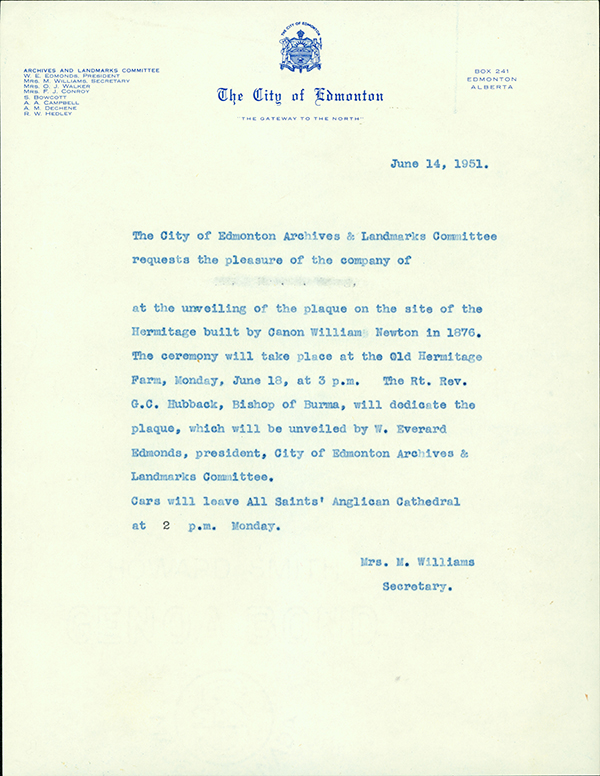
On June 18 1951, the Archives and Landmarks Committee unveiled a plaque commemorating Cannon William Newton and the Hermitage.
Cannon Newton was an Anglican minister who arrived in the Edmonton settlement in 1875 and erected a dwelling 10 kilometres east of the Fort.
He called his home Hermitage, and it grew to consist of a library, a school, a hospital, and a chapel. He planted lilacs in the garden, where they still grow today.
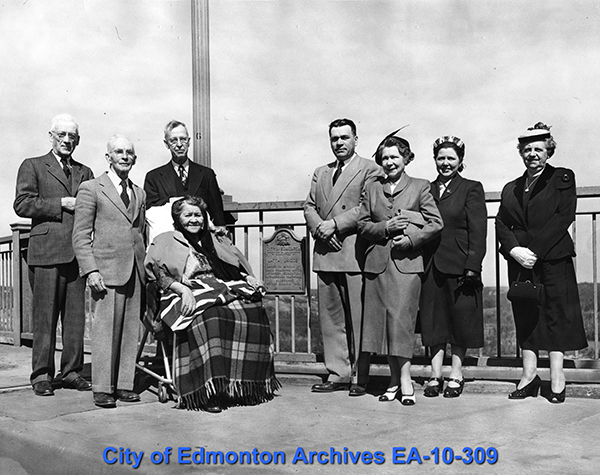
The Latta Bridge was named after David Latta, a North West Mounted Police officer and blacksmith who arrived in Edmonton in 1897.
Latta was elected Alderman in 1906. In 1907, he built a house next to the ravine which bears his name.
As early as 1911, a trestle bridge spanned the Latta Ravine. However, due to increased traffic, it was replaced with a steel structure in 1936. It was never formally named, and for many years was known as the Latta Bridge. It was also known as the Elks Bridge after the Benevolent and Protective Order of the Elks, whose fraternal hall was nearby. It was at the request of the Archives and Landmarks Committee that the bridge be formally named for Latta.
[EA-10-309]
Plaques & Place Markers Photo Gallery
![Hermitage land grant 1894 [EA-10-2933]](/sites/default/files/public-files/images/caemw_ea102933_600w.jpg)
!["What Happened at the Hermitage" [EAA-1-27]](/sites/default/files/public-files/images/caewm_eaa127_600w.jpg)
![Hermitage Mission plaque 1951 [EA-10-2401]](/sites/default/files/public-files/images/caemw_EA102401_600w478h.jpg)
![Hermitage Mission, n.d. EA-10-1794]](/sites/default/files/public-files/images/caemw_EA101794_600w345h.jpg)
![Hermitage Mission, 1959 [EA-10-563]](/sites/default/files/public-files/images/caemw_EA10563_600w403h.jpg)
![David Latta 1915 [EA-40-18]](/sites/default/files/public-files/images/caemw_ea4018_600w.jpg)
![Latta house 1900s [EA-10-526]](/sites/default/files/public-files/images/caemw_ea10526_600w.jpg)
![Mrs. D. G. Latta 1952 [EA-10-308]](/sites/default/files/public-files/images/caemw_EA10308_600w762h.jpg)
![Latta Bridge 1952 [EA-10-309]](/sites/default/files/public-files/images/caemw_ea10309_600w.jpg)
Recognition of Historic Trees
Today, trees are often given heritage value. In the 1940s and 1950s however, much of the emphasis was on architecture. Therefore, it was a rather progressive move when the Archives and Landmarks Committee identified several trees as historically significant.
In keeping with their focus, these trees relate to early Edmonton's leading men. A list was compiled and sent to the City of Edmonton Parks Department with a request that the trees be given special care.
Factor Hardisty’s Tree
This Manitoba maple tree was planted by Richard Hardisty around 1875 as part of a row that circled his garden. Hardisty was Chief Factor of the Hudson's Bay Company from 1872-1882, and was an important part of Edmonton's history. He built the first house outside the walls of the Fort, and became Alberta's first Senator in 1888.
In 1954, the tree was moved from its original location to the south side of the Legislature grounds to make way for the new Highways Building (106 Street and 97 Avenue).
Unfortunately, the tree failed to take in its new location and died in 1958.
Garneau's Tree
Another Manitoba maple tree was planted by early homesteaders Laurent and Eleanor Garneau at the rear of their home. Laurent was Métis, and well known in the area as an excellent fiddler, as well as for his role in the Red River Rebellion of 1869, where he served as one of Louis Riel's soldiers. The Garneaus moved to the south side of the North Saskatchewan River in 1874, where Laurent worked for the Hudson's Bay Company as a charcoal burner and later as a freighter, before moving to St. Paul in 1901.
Around 1943, Ella May Walker interviewed the daughter of Robert McKernan, Annie (McKernan) Turnbull, as part of her research for Fortress North. In this interview, Mrs. Turnbull recalls her childhood memories of the 1875 North-West Rebellion. Fear was rampant among settlers, and many false reports circulated of marauding parties of Métis and First Nations. As described in the interview, one such report caused nearby settlers like the McKernan family to seek shelter behind the walls of Fort Edmonton, and resulted in the brief imprisonment of Laurent Garneau at the Fort.
Annie Turnbull interview with Ella May Walker
[MS-52 Item 5]
The Archives and Landmarks Committee placed a plaque at the juncture of 110 Street and Saskatchewan Drive in 1953 to commemorate Garneau and the tree.
Thirty years later, in 1983, a second plaque was erected by Frances Cruden through an Emil Skarin Fund grant from the University of Alberta. This plaque was at the base of the Garneau Tree on 111 Street just north of 90 Avenue.
The tree was removed for safety reasons in September 2017.
Historic Trees Photo Gallery
![Richard Hardisty [EA-10-1557]](/sites/default/files/public-files/images/caemw_EA101557_500w737h.jpg)
![Hardisty tree [EA-10-100]](/sites/default/files/public-files/images/caemw_ea10100_600w.jpg)
![Hardisty's Tree in 1949 [EA-10-678]](/sites/default/files/public-files/images/caemw_EA10678_400w713h.jpg)
![Hardisty’s garden in 1909 [EA-10-1660]](/sites/default/files/public-files/images/caemw_EA101660_600w423h.jpg)
![Drawing of Hardisty's house [EA-10-82]](/sites/default/files/public-files/images/caemw_ea1082_600w.jpg)
![Eleanor and Laurent Garneau, c. 1898 [EA-58-3]](/sites/default/files/public-files/images/caemw_EA583_600w829h.jpg)
![Garneaus’ Home [EAA-1-4]](/sites/default/files/public-files/assets/caemw_eaa14_430w.jpg)
![Garneau Memorial [EA-4-47]](/sites/default/files/public-files/images/caemw_ea447_600w.jpg)
![Garneau Memorial plaque [EA-4-48]](/sites/default/files/public-files/images/caemw_ea448_600w.jpg)
Contact Us
City of Edmonton Archives
Prince of Wales Armouries, 2nd floor
10440 108 Avenue
Edmonton, Alberta
Email cms.archives@edmonton.ca