


The Humberstone Mine Company was established in 1900. The coal mined came from the Clover Bar seam, which was between five and seven and a half feet thick. Over the thirty-four years the mine was active, more than 980,000 tons of coal was pulled from the ground.
Introduction
The original mine entrance was a horizontal shaft, called a drift, located on the riverbank just south of the present-day Clover Bar Bridge. In 1900 the mine had a capacity of ten tons of coal daily. Over the next two decades many improvements were made. Around 1910, a new shaft was dug and a spur track was laid to connect the Humberstone Mine to the Grand Trunk Pacific Railroad. This track ended at the shaft and made loading and shipping the coal much easier. The old drift entrance from 1900 was fitted with a fan house to help ventilate the mine. Five smaller fans also operated, keeping the mine dry as well. Electric light was available at the bottom of the main mine shaft, but miners’ lamps were required everywhere else.
Agreement between William Humberstone and the Town of Edmonton
(RG-8 Contract #17 – 1900)
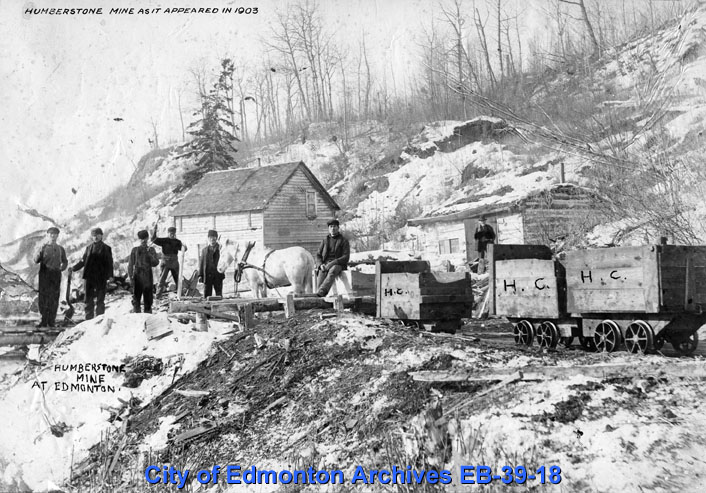
[EB-39-18]
Life at the Mine
In the late 1910s, the Humberstone Mine had 200 employees in the busy winter season, with a monthly payroll of $25,000. Because the mine was relatively isolated it became a community unto itself. Over 100 men were housed and fed on site, and their camp was reportedly one of the best in the west.
Although no large disasters ever took place, safety remained a concern. There were several reports of fires in the coal seam between 1901 and 1929. In his 1971 work Atlas: Coal-mine Workings of the Edmonton Area, geologist Richard Spence Taylor remarked “It would not be surprising if fire still smouldered in some part of the waste in these workings.” There could also be fires in the buildings, such as the one that destroyed the power house around 1915.
Cave-ins were also a problem. A slope was dug in 1909 to connect with new shaft workings, but by 1910 it had collapsed and was abandoned. Flooding was a problem as well. In 1915 water broke into the shaft mine and flooded it. This was apparently caused by pillar-pulling which resulted in caving to the surface, and which allowed surface runoff into the mine. Similar caving to the surface occurred in 1917.
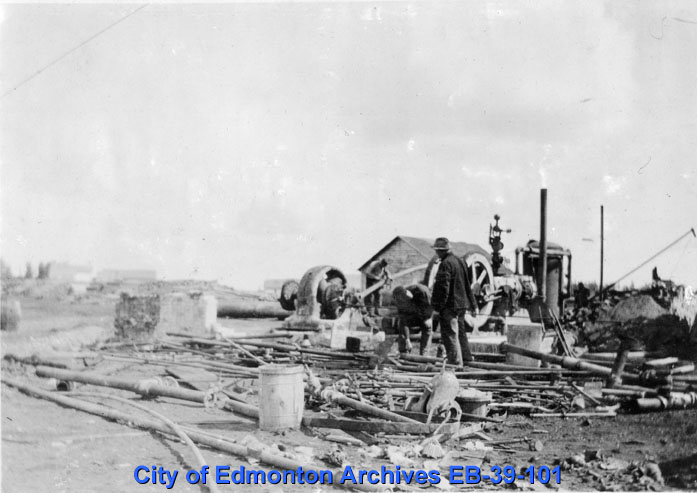
[EB-39-101]
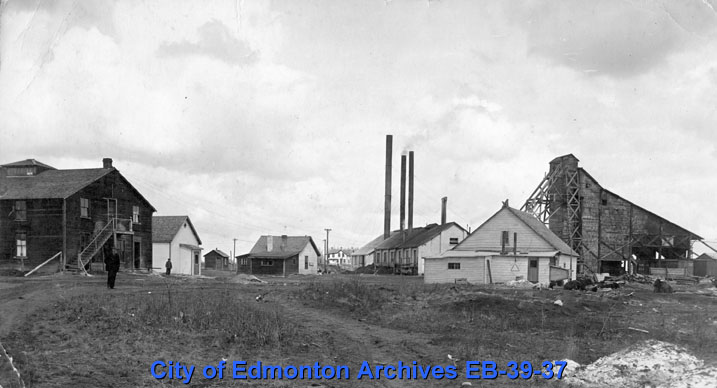
[EB-39-37]
Humberstone Mine Photo Gallery
![Plan of the Humberstone Mines, 1917 [EAM-233]](/sites/default/files/public-files/feature_images/EAM-233_212x139.jpg)
![Humberstone Mine as it Appeared in 1903 [EB-39-18]](/sites/default/files/public-files/images/EB-39-18.jpg)
![Humberstone Mine, 1903 – Teams Loaded on Ice [EB-39-19]](/sites/default/files/public-files/images/EB-39-19.jpg)
![Humberstone Coal Mine Co., ca. 1910 [EB-39-76]](/sites/default/files/public-files/images/EB-39-76.jpg)
![First Railway Train on the Property, 1910 [EB-39-86]](/sites/default/files/public-files/images/EB-39-86.jpg)
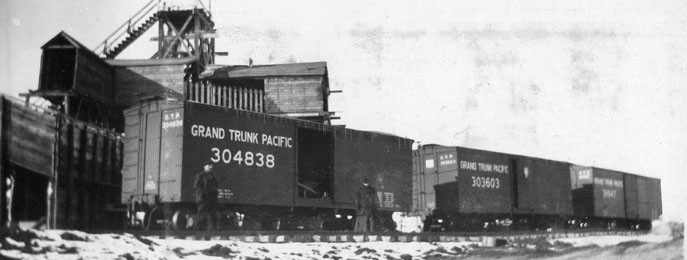
![Front of Sales Office, 1917 [EB-39-41]](/sites/default/files/public-files/images/EB-39-41.jpg)
![Humberstone Coal Company’s City Office, 1917 [EB-39-54]](/sites/default/files/public-files/images/EB-39-54.jpg)
![Humberstone Coal Mine, ca, 1917 [EB-39-37]](/sites/default/files/public-files/assets/EB-39-37page.jpg)
![Employees of Humberstone Coal Co., 1917 [EB-39-148]](/sites/default/files/public-files/images/EB-39-148.jpg)
![Pay Day at Humberstone Mine, ca. 1917 [EB-39-3]](/sites/default/files/public-files/images/EB-39-3.jpg)
![First Camp Cook at Mine, ca. 1915 [EB-39-141]](/sites/default/files/public-files/images/EB-39-141.jpg)
![Winter Conditions, ca. 1917 [EB-39-44]](/sites/default/files/public-files/images/EB-39-44.jpg)
![Can this Fan Ventilate? Ca. 1917 [EB-39-53]](/sites/default/files/public-files/images/EB-39-53.jpg)
![A Disastrous Fire and Flood Occurred in 1915 [EB-39-101]](/sites/default/files/public-files/images/EB-39-101.jpg)
Contact Us
City of Edmonton Archives
Prince of Wales Armouries, 2nd floor
10440 108 Avenue
Edmonton, Alberta
Email cms.archives@edmonton.ca