

Learn how to travel with new and existing bike routes on your bike, in your car, and on foot.
What You'll See Around Edmonton
Bike Lanes and Paths
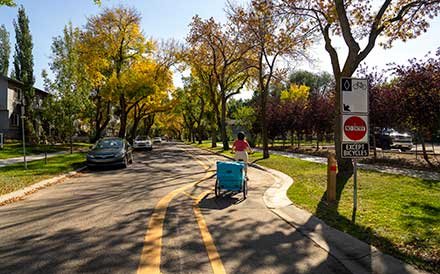
These lanes are installed on some one way streets to give bikes a dedicated lane to ride against the flow of traffic.
When you bike with traffic:
- Share the lane with vehicles
When you bike against traffic:
- Travel in the contraflow bike lane. A single or double solid yellow line on the road separates the bikes in the contraflow bike lane from the cars.
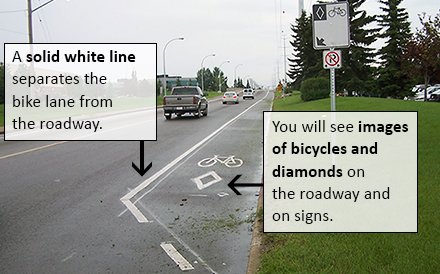
Painted bike lanes reserve space on the road exclusively for bikes
In Your Car:
- When you are driving beside a painted bike lane, you need to pay special attention when turning right at an intersection or accessway such as an entrance into a parking lot or driveway
- Wait for the solid line to become dashed, shoulder check to look for a cyclist and then, when safe, enter the lane
On Your Bike or In Your Car:
- Bike lanes are dashed before an intersection to indicate to cyclists where a left turn bay starts
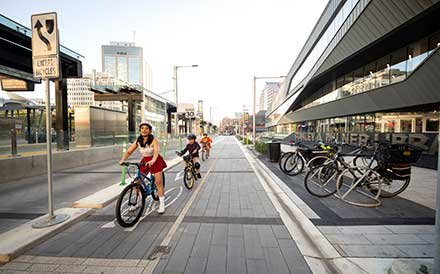
Protected bike lanes are on-street bike lanes protected from moving and parked vehicles by a physical barrier. Protected bike lanes may allow for travel in one or both directions.
On Your Bike:
- Watch for signs and paint symbols indicating the direction of travel
In Your Car:
- Look both directions and yield to bikes when crossing and turning
Local street bikeways are becoming an important part of our city's active transportation network. Based on Edmontonians’ feedback and emerging best practices in design, we’re implementing a new type of cycling facility. Local street bikeways are designed for people of all ages and abilities to feel comfortable cycling on quieter residential streets, even without dedicated bike lanes.
What is a local street bikeway?
A local street bikeway is a bike route, that also accommodates scooters, rollerblades,and similar, on low-traffic and low-speed streets, for example, on local roads with a posted speed limit of 30 km/h, where people cycling share the road with motor vehicles. These bikeways prioritize safety and comfort through:
- An updated posted speed limit of 30 km/hr
- Traffic-calming measures like speed humps, curb extensions and centre medians to encourage slower vehicle speeds
- Vehicle traffic diversion elements to reduce the volume of vehicles using the street
- Signage and pavement markings that clearly show it's a shared space
- Bike detected signals, two-stage crossings and other crossing designs to allow cyclists to safely cross busier roadways
Goals of Local Street Bikeways
Local street bikeways are designed to:
- Reduce vehicle speeds and traffic volumes through built-in street modifications
- Support all road users by making streets safer for biking, walking and driving
- Increase accessibility by connecting people to parks, schools, local businesses and other active transportation infrastructure
- Offer adaptable and permanent solutions for long-term street improvements
- Improve roadway safety for everyone
How are local street bikeways different from shared roadways?
A local street bikeway has enhanced design features that differ from the existing shared roadway routes.
There are existing shared roadways in Edmonton where signage and pavement markings remind people biking and people driving to share space safely on lower-volume roads. Unlike local street bikeways, the existing shared roadways do not include specialized features like traffic-calming measures or traffic diverters.
Design Guidelines Update
The City is updating its design standards for local street bikeways to improve safety and the user experience. This update will focus on incorporating traffic-calming elements and intersection improvements, guided by the Bike Plan and the Bike Plan Implementation Guide. These standards are part of a broader effort to expand the active transportation network through the Active Transportation Network Expansion Program, with a focus on redeveloping areas within Anthony Henday Drive. These updates will emphasize:
- Enhanced intersection features
- Expanded use of traffic-calming devices
- Improved route visibility and wayfinding
- Ensuring adequate clear lane widths for cyclists and vehicles to pass safely
A seasonal program to support active modes of travel and provide more opportunities to enjoy the outdoors during the warm season.
- A vehicle lane is converted for people to use for physical activity; similar to a shared pathway, they can be used to cycle, run, walk and more
- Temporary flex posts are installed to separate mobility lanes from vehicle traffic so people can bike, scoot, roll and walk comfortably and safely in a separate lane
- The speed limit on the adjacent roadway is reduced to 40 km/h where the lane is not separated by a median
- Temporary ramps are set up at the access points allowing pedestrians, bikes, strollers, wheelchairs and other wheeled devices to move from the curb to the street pavement or vice versa
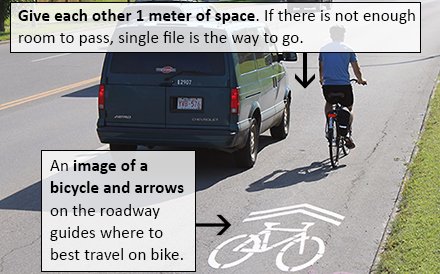
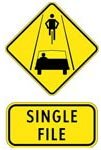
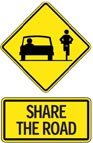
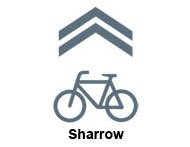
People cycle and drive along the roadway. These routes are marked with blue or green bike route signs or painted markings on the roadway.
The Safe Passing Distance Bylaw provides clear guidance for how much room people driving need to leave to safely pass people biking on the street.
In your vehicle:
- Pass safe, leave space; leave 1 metre between you and the person biking where the speed limit is 60 km/h or less, and 1.5 metres where the speed limit is greater than 60 km/h
- You may cross the solid yellow line, when safe, to give the required space
- People biking or scooting on the street may be riding in the middle of the lane to avoid obstacles and debris close to the curb
- Wait until it’s safe to pass, it won’t add much time to your trip
On your bike:
- The road marking guides where its best to travel on your bike
- Ride far enough out from the curb to avoid obstacles and to help people driving see you
- Ride in a straight line, rather than weaving in and out of parked vehicles
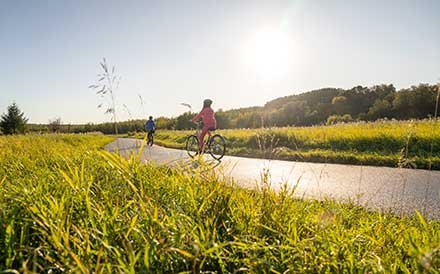
Shared pathways, which are paved, and trails, that are hard packed with gravel, wood chips or dirt, are for many activities. You can bike, walk, run and more.
On Your Bike:
- Use the path to travel in both directions
- Ring your bell to pass
- Slow down and pass on the left
- Yield to slower users
On Your Feet:
- Be aware that others may choose to pass you on your left
In Your Car:
- Check both directions and check for bikes when crossing a shared pathway
Some sidewalks may be designated as Shared Pathways or Shared Use Sidewalks. Watch for signs. Shared-use sidewalks are typically 2.5 m or wider and are marked with signs that indicate that they are shared. Watch for signs.
A complete list of shared-use sidewalks is available under Bicycle Highways in the Traffic Listing Document.
On your bike:
- Yield to pedestrians on shared-use sidewalks and ring your bell before passing
- Bicycles with wheels less than 50 cm in diameter, such as children's bicycles, are permitted on any sidewalk
Cycling Infrastructure
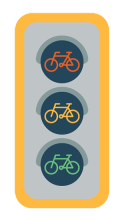
Bicycle signals are located throughout the city’s bike network. When present, refer to these signals when crossing intersections.
Bike-triggered crossings help people cycling to cross at intersections.
On Your Bike:
- Watch for a blue light and a "Bike Detected" sign
- If you have been detected, the light will turn blue
- Cross when the pedestrian signal turns to a “Walk” light
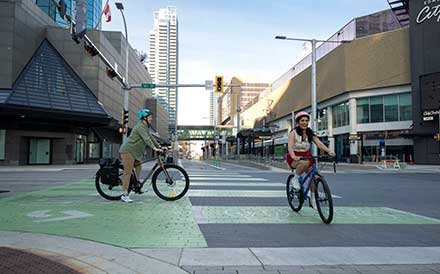
Green Bike Boxes painted in a driving lane allow people cycling to do two things:
- Pull in front of waiting traffic at a signalized intersection, making people cycling more visible and giving them a head start when turning or going straight
- Make safe turns by using it as a Bike Turn Box
If the Light is Red
- Enter the Bike Box and position yourself in your direction of travel
- When the light turns green, proceed as normal
Videos
Get Behind It - The Bike Box 3 Way Intersection
Get Behind It - The Bike Box 4 Way Intersection
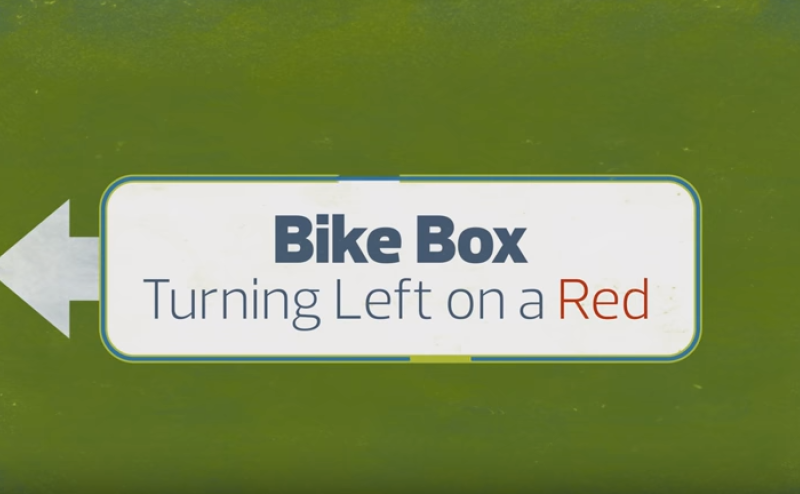
Bike Box Video: Turning Left on a Red
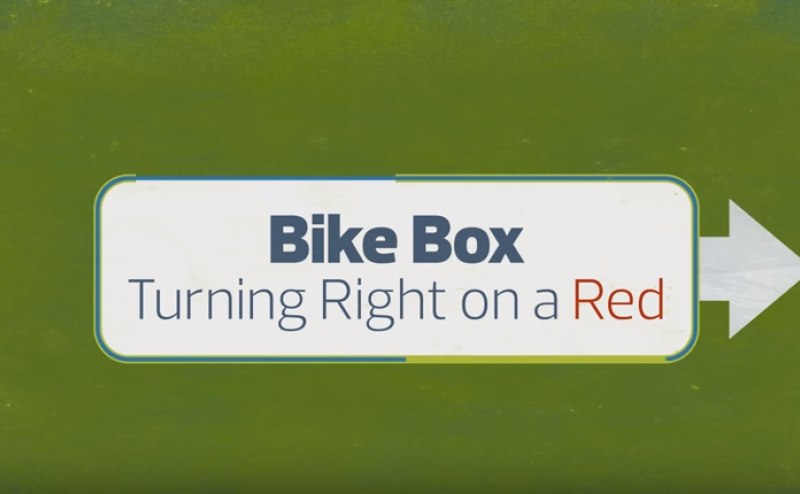
Green Bike Turn Boxes painted at intersections provide people cycling with a safe way to turn left or right. These boxes can be found in the bike lane or in a driving lane.
On Your Bike:
- Move into the green box found either in a bike lane or driving lane
- Position yourself in your new direction of travel and wait at the red light
- When the light turns green, proceed through the intersection
- When stopped at an intersection, do not stop on the "X"
Videos
Note: Crossing two lanes of traffic to make a left or right turn from a protected bike lane is not permitted.
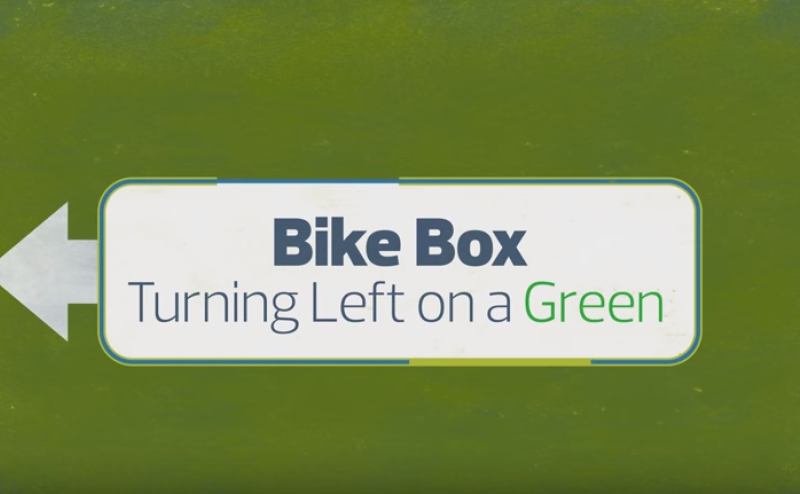
Bike Turn Box Video - Turning Left
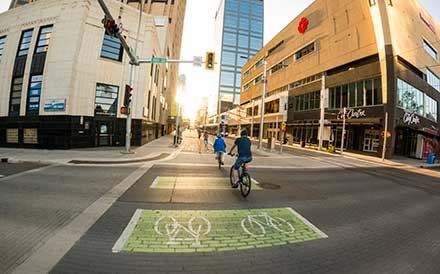
Striped green paint indicates that a bike lane is crossing an intersection or accessway such as an alleyway or entrance into a parking lot.
On Your Bike:
- Look both directions when crossing
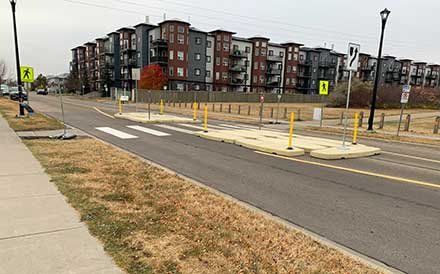
Two stage crossings allow people to pause between crossing each direction of traffic and narrow the street to calm and slow traffic and shorten crossing distance.
On your bike:
- Check for drivers and yield before crossing one lane at a time.
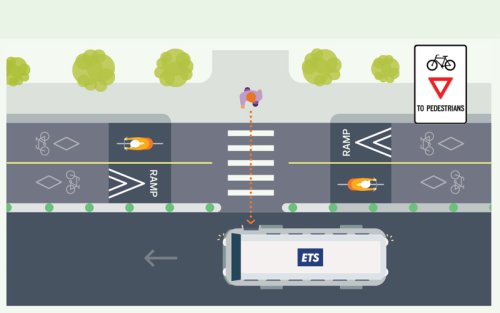
A raised crossing brings the level of the roadway to that of the adjacent bus stop. Transit users will be getting on and off the bus at this location.
On Your Bike:
- Slow down and yield to pedestrians getting on or off the bus
When a shared pathway crosses an intersection, the crosswalk may be lined with white squares. The Elephant feet markings indicate that you are in a shared space.
On Your Bike:
- Yield the right-of-way to vehicles unless otherwise indicated by a traffic control device such as a sign or signal
- Be aware of others
- Enter the cross when it’s safe to do so
- At a crosswalk with a pedestrian light, cross when the walk light is on
Cycling Laws and Safety
The Province of Alberta Traffic Safety Act, the City of Edmonton Traffic Bylaw and Public Spaces Bylaw contain formal regulations regarding bicycle traffic and use of transportation and parkland facilities.
- All bicycles must:
- Have 1 to 2 headlamps
- Have 1 red tail lamp
- Have 1 red reflector mounted on the rear
- Be equipped with 1 bell or horn
- Have working brakes, steering and brakes that will lock wheels on dry, clean, level pavement
- All cyclists must:
- Wear a helmet if under the age of 18 or when operating a power bike* or e-bike*
*Rules & Regulations Applying to Small Vehicles
- Wear a helmet if under the age of 18 or when operating a power bike* or e-bike*
- Alert people ahead of them before passing
Cyclists have the same rights and responsibilities as motor vehicles. They're allowed on all roads as well as shared pathways, bike lanes, and bike routes.
Cyclists have the same rights and responsibilities as motor vehicles and must obey all rules of the road. They're allowed on all roads as well as shared pathways, bike lanes and bike routes.
Licence and Registration
Bicycles are not required to be licensed or registered. A bicycle licence is not required for police officers to enforce the current traffic laws. Cyclists are accountable in the same way that motor vehicle drivers are, and may be ticketed in accordance with local and provincial legislation.
Safe Passing Distance
In order to make our streets safer for everyone regardless of how they move around Edmonton, the City has passed a Charter Bylaw to set minimum safe passing distances that motor vehicle drivers need to give cyclists when passing them on the road.
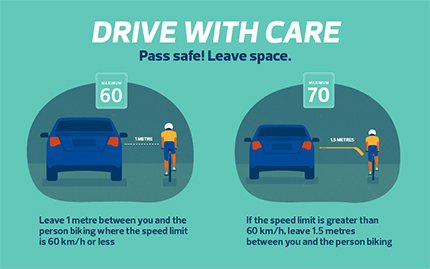
The required distance is a minimum of 1 metre between the vehicle and the bicycle where the posted speed limit is 60 km/h or less, and 1.5 metres between the vehicle and the bicycle where the posted speed limit is greater than 60 km/h. This change went into effect on September 30, 2021.
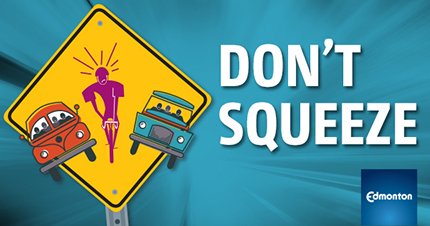
Don’t Squeeze
Cyclists should not pass between two occupied vehicles, even if they are stopped at a red light.
The Door Zone
Use caution and be mindful of the door zone when cycling past or exiting a parked car. The Door Zone is the area along the side of a parked car where an opening door can hit and seriously injure a cyclist.
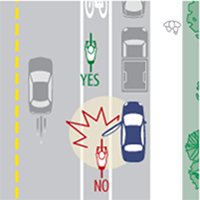
On Your Bike
When riding in a bike lane, ride on the left side of the lane-away from parked cars. Try to look inside each parked car before you pass. If you’re unable to see if someone is inside, or if you spot someone inside, move outside the Door Zone or slow down and pass carefully.
In Your Car
When parked on the side of the road, do a shoulder check, over your left shoulder before opening your door to ensure there are no oncoming cyclists. Opening the door with your right hand will remind you to do a shoulder check.
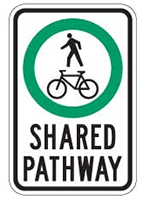
Cycling on the sidewalk is not permitted except for bikes with a 50cm wheel diameter or less, such as kids’ bikes.
Standard size bicycles are only allowed on signed, shared sidewalks that are 2.5m wide or greater and shared pathways.
Where permitted by signs to use a sidewalk, always give right-of-way to pedestrians and always give audible warning of your approach.
Shared pathways and Trails are used for a variety of activities, including walking, running and cycling.
Park and Trail Hours
Hours of Operation: 5am-11pm daily
Parks and trails are monitored by Park Rangers, who provide bylaw enforcement and education to park users.
Trail and Shared Pathway Safety
People on bikes are responsible for following these rules:
- Bicycles must have a working bell. Park rangers can issue a $100 ticket to trail users who do not have one.
- Bike riders must sound their bell before passing slower trail users. Park rangers can issue a $250 ticket to trail users who fail to alert people ahead of them before passing.
- Slow down when you approach slower users and pass on the left side.
- Obey trail signs and park closures.
- Do not bike on or disturb trails that are less than 0.5m wide, as they are part of the natural landscape or wildlife routes.
Cyclists are required to have certain equipment based on provincial and municipal regulations. Essential equipment when cycling:
- A bell or horn
- A bicycle brake
- When cycling at night a white headlamp, a red tail lamp and a red rear reflector
- If under the age of 18, a helmet
Helmets
Alberta Traffic Safety Act, Part 6 Division 5 Section 111 & 112:
- Cyclists younger than 18 are required by law to wear an approved bicycle helmet
- Children in trailers and on trail-a-bikes are required by law to wear an approved bicycle helmet
- Adults are encouraged to wear a helmet
- Helmets must meet ANSI, Snell or CSA standards to provide enough protection
Make Sure It Fits
- The helmet fits snugly, is level front to back, and sits an inch above your eyebrows
- Adjust the straps so the 'V' is below you ears and you can fit two fingers between your chin and the strap
Brakes
By law bicycles must be equipped with adequate steering and brakes that will lock wheels on dry, clean, level pavement.
Bicycle Equipment – Part 6 Division 5 Section 113
Tips
- You may not stop in time if you brake with only one hand
- Allow extra distance for stopping in the rain: wet brakes are less effective
- Contact Bike Edmonton for advice and workshops about keeping a bike in good repair
Bell
Cyclists must sound a warning device, such as a horn or bell, before passing pedestrians on shared pathways and must always give them the right of way.
City of Edmonton Traffic Bylaw 5590 - Part III Sidewalks and Boulevards - Section 50
Alberta Traffic Safety Act - Horn, Bell - Section 60
Lights and Reflectors
When riding after dark, bicycles must have a front headlight, a red tail light and a red rear reflector. Reflective vests and other lightly coloured clothes with reflective tape are recommended for extra visibility.
Bicycle Equipment – Part 6 Division 5 Section 113
Cyclists should consider using the following equipment to improve visibility and safety:
- Brightly-coloured and weather specific clothing
- Padded cycling gloves
- Protective or sun glasses
- A flag on your trailer
- Pack or a rack
Appropriate Clothing
Brightly coloured or reflective clothing make cyclists more visible on roads and paths. Weather specific clothing will keep you warm, dry, and prepared for any temperature changes. Glasses and gloves will protect you from dust and debris. Wear a helmet with a hard outer shell and crushable, foam lining. Don’t wear headphones or earbuds: hearing traffic is an essential part of safe riding.
Use Flags on Bicycle Trailers
Trailers may be difficult for motorists to see. Use a red flag on the trailer at rider height to alert motorists of your presence.
Use a Pack or Rack
Saddlebags, racks, baskets and small backpacks are great ways to free your hands for safe riding.
Navigate Bike Routes
Navigate Bike Routes
Frequently Asked Questions
Riding a bicycle, e-scooter or e-bike is not permitted on sidewalks. This does not apply to shared pathways or children 16 years and younger.
Here are a few risks of riding on the sidewalk:
- Drivers are not expecting cyclists to be on the sidewalk, increasing chances of collisions when drivers are entering or exiting alleys and parking lots
- Sidewalks are narrow and full of obstacles, which creates potential conflicts between people walking, biking, driving, wheeling, getting on and off buses, or emerging from building entrances
Some sidewalks may be designated as shared sidewalks and shared pathways. Watch for signs.
Based on the Traffic Safety Act, all rules that apply to pedestrians also apply to individuals operating mobility aids, therefore people using mobility aids are not permitted in bike lanes and should use the sidewalk instead.
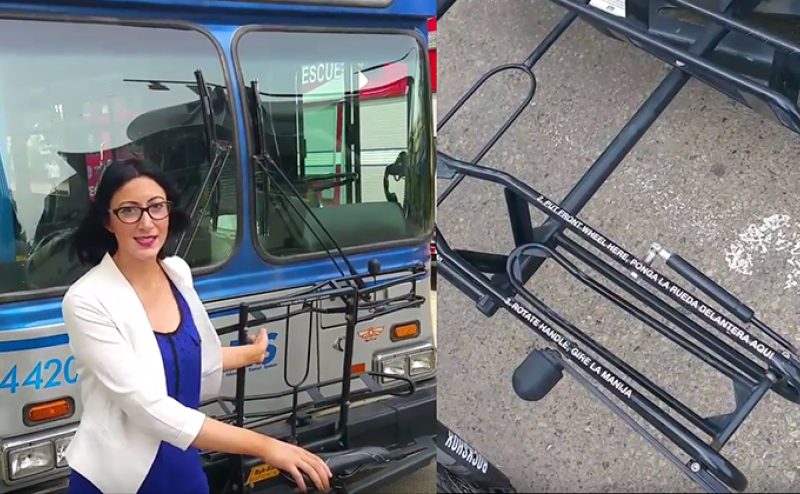
If you are travelling on transit with your bike, more information can be found at Bikes and E-scooters on ETS.
The City of Edmonton has wayfinding signs and maps to help you navigate around Edmonton. See Bike Route Wayfinding to see how wayfinding signs are designed to help people navigate the city’s bike network.
Bike Maps and Routes provides you with maps that show biking routes all across Edmonton.
Discover YEG is an online map of pathways, bike lanes and more, with each kind of infrastructure in a different colour.
There are also maps in PDF format for you to download.
Contact Us
Phone In Edmonton 311 | Outside of Edmonton 780-442-5311 | TTY 711
Link Contact 311 Online