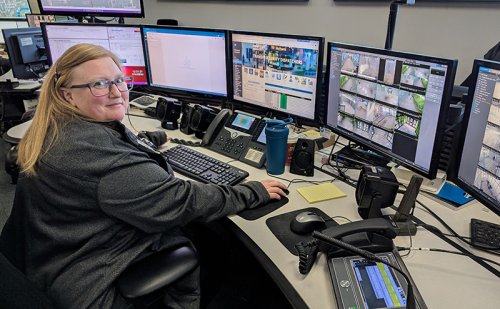
We want everyone to feel safe every time they board a bus or train. ETS takes a multi-layered approach to safety and security, and staff in our Control Centre monitor transit service 24 hours a day, seven days a week. Your safety is our top priority.

To find out more about what the City and partners are doing to keep transit safe for everyone, visit Transit Safety Plan.

Transit Watch Program

Our Transit Watch program is one way riders can report safety concerns, like harassment, disorder or suspicious behaviour, directly to ETS staff in our Control Centre.

Call or text Transit Watch at 7804424900, anytime.

For emergencies, immediately call 911

transit-watch-logo

How to Report a Concern & Use Text Services

How do I report a safety concern?

Text Message

  • To discreetly report immediate safety concerns to ETS staff, any time of day, text 780-442-4900. For emergencies, immediately call 911.
  • Please provide detail in your text message - for example: Are you on a bus? Which bus? Are you on a train? What LRT station is coming up next? What is the situation? Specifics are important.
  • The text message will be received by ETS staff in the Control Centre, and they will respond to you as quickly as possible. 


Phone

  • Call Transit Watch at 780-442-4900. For emergencies, immediately call 9-1-1.
  • If possible, use an emergency blue phone (located on LRT platforms and transit centres) to report harassment, disorder, or suspicious behaviour. Do not call until you are a safe distance away (approximately 300 feet).
  • Do not confront suspicious individuals or touch suspicious objects, packages or substances.
When should I text and when should I call 911?

The text message tool should be used to discreetly report immediate safety concerns, such as harassment, disorder or suspicious behaviour. For emergencies, immediately call 911.

For general information, like route or schedule inquiries, customers should continue to use edmonton.ca, Google maps or call 311.

If I send a text message, will it cost me anything on my phone bill?

Standard rates apply. Please check with your wireless carrier.


Can I send photos or video clips via text?

No, we can not receive photos or videos through our text number at this time. We are looking to include photos and videos in the future.


How fast is the text response? Who is responding?

ETS staff monitor this text line around the clock. Once a text is sent to the Transit Watch line, a confirmation text should be sent within a minute or two. Staff do their best to respond with a text as quickly as they can. If there happens to be multiple texts at one time, ETS staff are highly trained and will prioritize and dispatch resources appropriately. Depending on the nature of the safety concern and the location, it may take security resources or ETS staff several minutes to be on location. In cases of emergency, call 911.

What if the person texting is a minor. Will there be a different response?

Anyone can report a safety concern, regardless of age. The nature of the concern will guide the type of response. Sensitivity is exercised in all responses. If the concern involves a minor, staff will ask questions to determine the appropriate resource to deploy. Reports should include location, nature of concern along with any other relative details which may assist (location, bus number, direction of travel or next station if on the LRT, description of people involved, and so on).

Does the text message service work when there is no cell service?

There are certain locations on transit, namely underground LRT tunnels, where cell service can be spotty. In these situations we recommend, if you feel comfortable, waiting until you have cell service, or if not, pushing a help button on the LRT that will allow you to communicate directly with the Operator of the train.  

Safety and Security Staff

Transit Peace Officers

Peace Officer

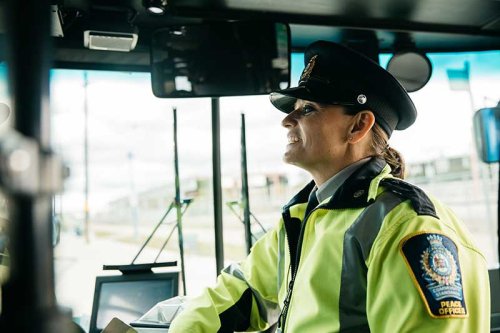
Transit Peace Officers are highly trained and skilled to proactively respond to a variety of situations to keep you and fellow transit riders safe. They work with our Control Centre and collaborate with police officers to keep Edmontonians safe.

Transit Peace Officers

Community Outreach Transit Team

community-outreach-officers-5072-2319-800x494

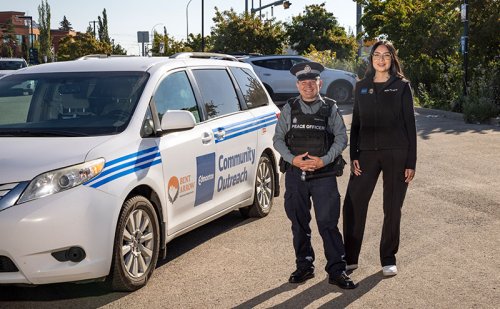
Transit Peace Officers also partner with outreach workers and other community agencies to help refer individuals on ETS property to specialized community support and services, such as financial, housing, mental health and substance use. The City is partnering with Bent Arrow Traditional Healing Society to provide the outreach workers to support this initiative. 

Community Outreach Transit Team

Transit Security Dispatchers

Transit Security Dispatchers

Transit Security Dispatchers work in the Control Centre and provide behind-the-scenes safety and security support.

Safety Around the LRT

Escalator Safety Tips in LRT Stations

Escalators are common throughout the LRT system and it’s important to use them safely.

If you are travelling with mobility aids, strollers, bicycles, baggage and other devices, you should use an elevator instead for your safety and for the safety of others. These items can also cause damage to the escalator.

Watch how you step on and off the escalator. Untied shoelaces, loose clothing or bags can get caught in the moving parts and an unplanned step could lead to a fall. Stay aware of your location and be ready to step on and step off at the top.

Please keep to the right so others can use the left side to pass.  When you leave the escalator, please move out of the way so that others behind you can get off quickly and easily.

Staying safe around LRT doors

Doors are unlocked once the train has come to a complete stop. The train cannot move again until all doors are closed and locked. Please do not block the doors or prevent them from closing.

Although the doors are locked and unlocked by the operator, you control when the doors open by pushing the door buttons inside or outside the vehicle.

On some LRT cars, doors open to the inside. Stand back to allow the doors to open.

A chime sounds when the doors are locked by the operator. This is also a warning that the train is about to move. The door buttons are no longer active once the operator has locked the doors. If a door is open when the chime sounds, it cannot be held open by pressing the door button. 

LRT Crossing Warning Bells

Warning bells can be noisy but they are necessary to alert motorists, pedestrians, and cyclists that trains are approaching the crossing. To balance the need for safety and reduce the impact to surrounding residential communities, the City has reduced the loudness of the crossing bells by:

  • Directing the sound toward the intersection
  • Reducing the number of bells that ring at each crossing
Gate Controls at above ground LRT Stations

Once the LRT gates have been activated and the arms start to go down (Belvedere, Stadium, Health Sciences/Jubilee Station, McKernan-Belgravia, South Campus, Southgate, Century Park), for safety reasons, the LRT operator will not reopen doors for the public to board.

When boarding or leaving the train, make sure anyone travelling with you and your belongings are on the same side of the door as you.

Safety on Buses

Stop Request

Stop Request is a program that allows passengers to get off a bus at a safe location other than a bus stop along the route. The program is an added measure of convenience and safety for bus passengers especially during winter. It is in effect daily after 6pm. You must let the Operator know directly (do not ring the bell) at least one stop in advance of where you wish to get off. Exit by the front door once the Operator is able to safely stop the bus.

Please note: The Stop Request program does not apply to ETS express or highway buses.

Retractable Bus Shields for Bus Operators

Retractable bus shields allow bus operators to open or close a power window within the shield if needed. 

Additional Security Features: Phones, Buttons, Alarms

Emergency Phones and Buttons

Blue emergency help phones are located in all LRT stations, in major bus terminals and in some city pedways. To use the phone, press the button and you will be connected directly with ETS control centre. When the phone is in use, a surveillance camera automatically starts to monitor/record the phone. Please note: these phones are different from the black information phones, which connect with 311 seven days/week (7am-7pm, closed statutory holidays).
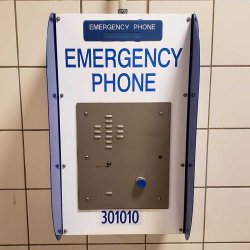
EmergencyPhonePhoto

Wall-mounted red emergency buttons are located in several areas in the downtown core, including the entrance to the Winspear Centre, the Winspear pedway, the Edmonton City Centre pedway and the Westin Hotel pedway. Pushing the button will connect you directly with the ETS control centre. When the button is activated, a surveillance camera automatically monitors/records the area.
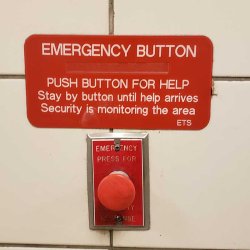
EmergencyRedButtonPhoto

Please note: The collection of recorded images using ETS security surveillance cameras is authorized under section 4(c) of the Protection of Privacy Act (POPA) and is managed and protected in accordance with the Act. 
 

Alert Systems on LRT Trains

There are several ways you can let the LRT Operator know if there’s an urgent or emergency situation on the LRT or you feel unsafe.  

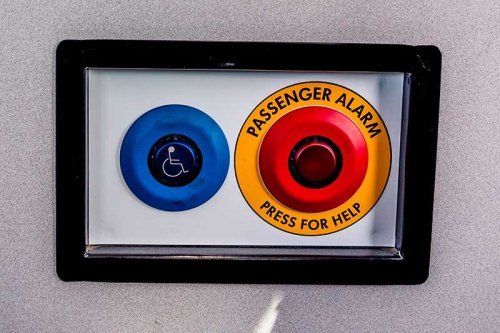
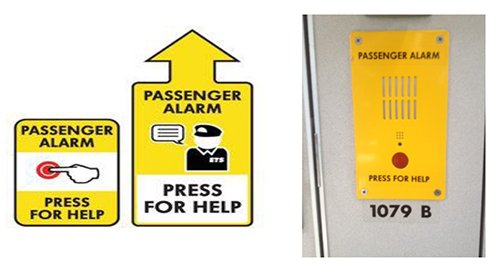
Yellow passenger alarms are located inside the LRT cars. Press the red button to activate.

lrt-passenger-alarm

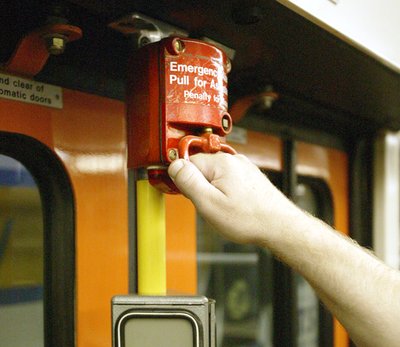
Red alarm handles are located in all LRT cars above every alternate door. Pull down on the handle to activate.

red button

Red emergency buttons are located on all LRT cars next to the door button.

LRTPAssengerAlarmsPhoto

Closed Circuit Television

 ETS control centre closely monitors the surveillance camera via Closed Circuit Televisions (CCTV). These cameras are installed on all buses and LRT cars, in all LRT stations, major transit centres and some city pedways.

When someone uses a blue emergency help phone or emergency wall button, a camera will automatically monitor the area. ETS control centre then connects with the person in need of help.  

For your safety and security, various surveillance and emergency communication equipment is installed throughout the Edmonton Transit Service, including transit centres and other facilities, buses, trains and LRT stations. The collection of recorded camera images is authorized under provisions in the Access to Information Act (ATIA) and Protection of Privacy Act (POPA).