

Learn more about coyotes and how to avoid coyote-human conflict.
Urban coyotes play a natural and beneficial role in the city as scavengers who help manage rodent and small mammal populations.
Problematic Coyote Behaviour Checklist
- A coyote does not move away from you when it is within 40 metres in a residential area during the day
- Coyote approaches you or your leashed pet within 20 metres (approximately the width of a standard residential lot) in any area at any time of day
- Coyote follows you or your leashed pet closely from a distance of less than 20 metres
- Coyote enters a fenced residential yard by jumping over the fence
- Coyote is seen repeatedly during the day in an area where there are children (for example: a playground, schoolyard, urban park)
- Coyote bites, nips or makes other physical contacts with a pet or person
When to Call 311
When a coyote makes contact with you or your pet or is exhibiting fearless or aggressive behaviour, always call 311.
It is also important to call 311 when:
- A coyote is so injured or sick that it cannot move
- A coyote is trapped in an area of your yard (private property)
- Someone is intentionally feeding coyotes
- You suspect coyotes have a den with pups in a residential area
What Happens When You Call 311?
Most calls to 311 we receive about coyotes do not require intervention from the city. These calls usually report sightings of coyotes exhibiting typical, non-alarming behaviour (for example: hunting and catching small rodents, following you or your pet at a distance of more than 40 metres, curiously gazing at you or your pet from a distance).
When an incident with a coyote is reported, we investigate and determine if a problem exists. An appropriate course of action is then taken. Depending on the circumstances, this can include monitoring the area for future reports, public education, putting up warning signs or using other coyote behaviour management strategies such as ‘hazing’. Lethal management of coyotes is always done as a last resort.
Information is logged to support ongoing analysis and identify hotspots of coyote activity.
Report is flagged for review by Park Rangers. Follow-up action may occur such as light hazing.
Area will be monitored for similar reports.
Park Rangers will investigate the location, may conduct hazing of coyote(s) and recommend actions by residents.
Park Rangers will investigate, and lethal removal of coyote may occur.
What To Do If You Encounter a Coyote
To prevent coyote attacks on humans, modern wildlife management focuses on behavioural conditioning (also called ‘hazing’ or ‘aversive conditioning'). This practice tries to change an animal’s behaviour by making every human-coyote encounter unpleasant for the animal. This method only works if we all respond to coyote encounters aggressively. If a coyote does approach, make it feel unwelcome. They should not feel comfortable around us.
Take These Immediate Steps:
- Clap your hands loudly and firmly toward the animal.
- Respond to its presence aggressively by making yourself appear large (wave your arms overhead or swing objects like a walking stick at the coyote).
- Throw rocks, sticks or other objects to scare it away.
- Carry a whistle or air horn and blow it to startle the animal.
- Carry dog spray in areas highly frequented by coyotes.
- Shout in a deep voice and maintain eye contact.
- Do not turn away or run. This may trigger a natural predator/prey instinct and might encourage the coyote to chase after you.
- If the coyote continues to approach, back away slowly and move toward buildings or human activity. Coyotes may remain near a source of food or a den site, and this could be the reason they refuse to leave. Be mindful of situations like this, and remove attractants if possible.
How to Prevent or Reduce Coyote Encounters
The presence of coyotes in our city is a sign of a healthy, balanced ecosystem. Coyotes are naturally curious and intelligent animals. It is common to see them travelling in parks, green spaces, roads and sidewalks while watching people and pets at a distance.
However, coyotes that have been desensitized to humans through food conditioning or coyotes protecting their dens or pups from off-leash dogs may become aggressive.
Coyotes are naturally afraid of people. But, when they eat food from yards, they become too comfortable around people and may display concerning behaviour. In addition, coyotes can carry a parasite called Echinococcus multilocularis that can be harmful to people.
You can help deter coyotes and other wildlife from your yard by:
- Cleaning up spilled garbage, food scraps and birdseed
- Opting for closed compost bins
- Securing your garbage in a protected container
- Cleaning up fallen fruit
- Keeping pet food inside
- Ensuring coyotes do not den on your property, such as under a deck or shed
Coyotes thrive without human food. But when fed by people, they are prone to disease and parasites, become too comfortable around people and may become aggressive.
Coyotes can be territorial and could consider your dog a threat. Coyotes may try to draw a dog away and attack it to eliminate the threat. Keeping your dog close on a leash at all times is the best way to ensure its safety.
The City of Edmonton's Animal Licensing and Control Bylaw requires owners to prevent their cats and dogs from roaming free and unsupervised off of their property. By permitting your pets to roam free outside of your property, you provide the opportunity for a potentially serious encounter between your pet and a coyote.
Remember, your pets rely on you for their safety.
- Close up areas under decks, porches or steps.
- Clean up large piles of wood, debris or garbage.
- Prune thick shrubs, low-hanging spruce boughs and other dense vegetation
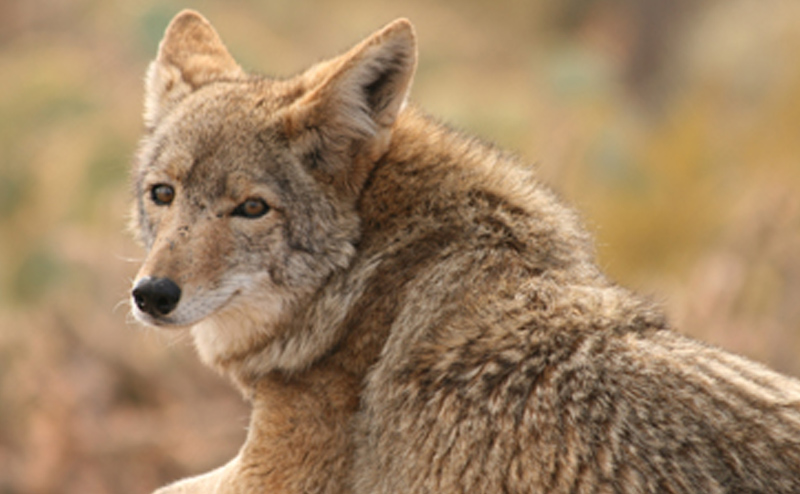
Coyotes are wild animals that are native to Edmonton, belonging to the Canidae (dog) family. They have long legs, oversized pointed ears, and large bushy tails with black tips. An average adult coyote weighs 9-14 kilograms and is just over a metre long from its nose tip to the tip of its tail. Coyotes have light grey or tan coats of variable lengths and slim pointed muzzles.
Coyotes have long existed alongside humans and have adapted to living within population centres because of the opportunities they present to foraging scavengers. As our city grows and expands into rural areas, more coyotes are adapting to food sources in residential areas by eating readily available backyard food sources such as garbage, food scraps, fruit and pet food.
Coyotes do not pose a threat to humans. The extremely rare cases of physical contact are almost always as a direct result of feeding or den defence. Coyotes have a weaker bite than wolves, foxes, most dogs and even humans!
Coyotes naturally hunt rodents and small mammals such as rabbits, hares, squirrels and gophers. Additionally, they are opportunistic feeders who may consume garbage, fruit or even insects. Coyotes do not look at humans as prey and are generally afraid of us, although urban coyotes can become desensitized to human activity or presence, especially if they are used to getting food near people. Coyotes perceive humans as being providers or resources they can exploit. Some people report an increased presence in neighbourhoods during garbage days or when garbage is placed out and easily accessible beforehand.
A new strain of tapeworm called Echinococcus multilocularis has been detected in urban coyotes in Edmonton. Between 60% and 80% of Edmonton’s coyotes carry or previously carried this parasite — a much higher proportion than most locations in North America.
In humans, this zoonotic parasite can lead to the development of parasitic tumours that can form in the liver, lungs, brain and other organs. Although human cases of this are rare, several have been identified in Alberta.
How Can Humans Become Infected?
Humans can be infected by the Echinococcus multilocularis tapeworm by accidentally eating microscopic eggs contained in the fecal matter of a coyote or dog that ate an infected rodent. The eggs can get caught on garden produce or a dog that rolls in areas where coyotes defecate. The eggs can also travel in wind and water and remain viable for a year or more.
Although the public should not be alarmed, people can still protect themselves by:
- Being aware of this disease and how it can spread
- Following good hand-washing hygiene, especially when working with soil
- Walking dogs on a leash
- Ensuring you, your children and your pets avoid coyote fecal matter
- Talking to your vet if your dog sometimes eats rodents
- Wash vegetables thoroughly from gardens where infected dogs or coyotes may have been
- Coyotes typically mate in late January or early February. The gestation period is approximately 63 days with an average litter of 6 pups. Pups leave the den in June or August.
- Dens are typically dug in steep banks in dense vegetation, but they sometimes occur in drainage pipes. Natural dens typically have multiple entrances.
- Coyotes used to live mainly in open grassland areas until the widespread extermination of wolves opened up new habitats. They are crepuscular, meaning they are most active at dawn and dusk.
- Coyotes are considered a species of Least Concern due to their large populations and widespread distribution.
- Coyotes carry a large range of diseases and parasites such as rabies, canine distemper, canine hepatitis, tularemia, mange, and tapeworm.
- Coyotes may perceive small dogs and cats as prey, and view larger dogs as threats or competition. Coyotes very rarely attack humans, but urban coyotes are becoming bolder across the continent.
Park Rangers Ryan Smar & Kara Marshall deliver a webinar on Urban Coyotes in Edmonton. Learn what to do if you encounter a coyote, how to coyote-proof your yard, what attracts coyotes & how you can help keep coyotes wild & decrease coyote-human conflict.
Educational Resources
Free E-Learning Module
Learn more about coyotes from Park Ranger Seamus in our new e-learning module. Developed in partnership with the University of Alberta’s Edmonton Urban Coyote Project, this module will cover why coyotes are in our city and some facts about their behaviour including ways to prevent negative encounters with them and your pets.
Contact Us
To Report a Problem Coyote, call
TTY: 780-944-5555 and press 0
Phone In Edmonton: 311 | Outside Edmonton: 780-442-5311
Link Contact 311 Online
Coyote Information Line
Phone 780-644-5744