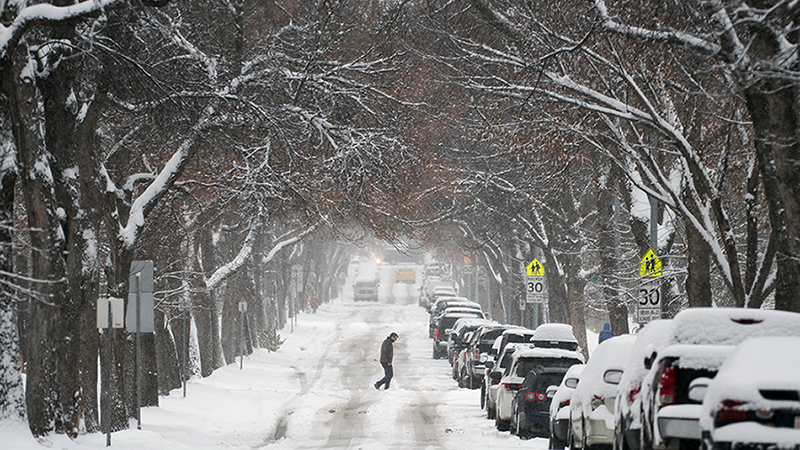
The City maintains main roads, bus routes, bike routes and multi-use trails, residential roads and alleys throughout the winter. Learn more about the snow clearing priorities on roadways and active pathways.
When it snows, the City has a plan to efficiently clear roadways, protected bike lanes, multi-use trails and city-maintained sidewalks and bus stops.
Snow Clearing During Snowfalls
While snow is falling, equipment and crews:
- Focus on clearing major roadways like Whitemud Drive and Yellowhead Trail
- Clear and apply sand/salt to on/off ramps, bridge decks and river valley hills
When snow stops falling, crews conduct snow clearing following the priorities in the Snow and Ice Control Procedures. These priorities for roadways and active pathways are determined by a variety of factors, including safety, traffic speed and volume, design of the infrastructure, usage and more.
Parking Ban Notices
Subscribe to Service Notifications to receive communications specific to your location.
Roadways Snow Clearing Map
See where the plows and snow clearing equipment are during and after snow events.
Active Pathways Snow Clearing Map
Includes priority levels of active pathways and the bike network.
Snow Clearing Priority Hierarchy
Roadways
Priority 1 focus areas: main freeways, major arterial roadways and downtown business districts, as well as alleys and back lanes in business districts.
Service Level:
For alleys and back lanes in business districts: maintain to 5 cm snowpack within 5 days following the end of snowfall.
For all other priority 1 focus areas: Maintain to a bare pavement standard within 1 day following the end of snowfall.
Parking Ban Phase: Major Roadways (Phase 1)
- The City clears major roads, including core business areas and bus routes
- Lasts up to 5 days
Priority 2 focus areas: remaining freeways, secondary arterial roads, collector roadways, transit routes and Park and Ride access.
Service Level: Maintain to a bare pavement standard within 5 days following the end of snowfall.
Parking Ban Phase: Major Roadways (Phase 1)
Priority 3 focus areas: industrial hubs and rural roadways
Service Level: Maintain to a bare pavement standard within 6 days following the end of snowfall.
Parking Ban Phase: As needed
Priority 4 focus areas: residential roadways and alleys/back lanes
Service Level: Maintain to 5 cm snowpack and completed within 14 days once a residential blading cycle is initiated.
Parking Ban Phase: Residential (Phase 2)
- Once a Major Roadways (Phase 1) parking ban is complete, the ban may shift to residential and industrial area roads
- No parking on these roads before and during snow clearing
- Lasts up to 14 days
- Impacts to individual communities expected to be less — approximately 3 days
Active Pathways
Priority 1 focus areas:
- inventory adjacent to City facilities (City Hall, recreation centres and seniors centres)
- transit centres and LRT stations (such as City-maintained sidewalks, wheelchair ramps, shared pathways, all-season staircases and bus stops)
- winter priority bike loop (a network of protected bike lanes, designated painted bike lanes and designated shared pathways)
Service level: Maintain to a bare pavement standard within 1 day following the end of snowfall.
Priority 2 focus areas: remaining machine-accessible, City-maintained sidewalks, shared-use pathways, parking lots and bridge decks.
Service Level: Maintain to a safe and passable surface beginning at the end of snowfall and completed within 3 days following the end of snowfall.
Priority 3 focus areas: manually cleared areas such as neighbourhood breezeways, public benches and fire hydrants.
Service Level: Maintain to a safe and passable surface within 14 days following the end of snowfall.
Priority 4 focus areas: community sandboxes and safe mobility devices.
Service Level: Completed when resources allow.
Additional Snow Clearing Information
Several methods are used to achieve a safe and reliable mobility network. The goal is to use the right tool and method for the current and forecasted condition.
Plows and Graders
The City uses both front and underbelly-mounted plows. Front mount plows allow for clearing of roads. Underbelly plows are used to break up snowpack. Graders are the most powerful pieces of equipment within our winter fleet, and most effective at snow removal. Graders are used during major snowfalls to clear main roadways.
Hand Tools - Shovels, brooms, blowers
In tight, small or awkward spaces such as stairs, sidewalks, trails and bus shelters, basic shovels and brooms are used by hand crews. These tools are able to clear hard to reach or tight spaces.
Salt, Sand and Chip
The City applies a mix of sand/salt pre-wet with calcium chloride to roads to maintain traction and/or melt snow and ice. The exact mix varies according to temperature and conditions and can change quickly in response to shifting weather conditions.
Chip is typically only used at very low temperatures in snow-packed areas to provide traction. The City tries to use as little of this as possible.
Anti-Icing
Calcium chloride brine with a corrosion inhibitor is currently in use for several purposes:
- On City-maintained sidewalks, protected bike lanes and active mobility pathways, including shared use paths), when the conditions require
- As a pre-wetting agent for the sand/salt mix that is dispensed by sanding trucks and sidewalk plows, as it prevents the mixture from freezing prior to being dispensed, results in a more even dispensing of product with less clumping, and improves the adherence of the mixture to road surfaces
Our approach to residential (Priority 4) roadways is designed to maintain safe travel conditions while balancing service levels with public disruption and snow storage requirements.
Key details of our residential snow clearing process include:
- Widespread clearing of residential roadways is initiated only when the snowpack on the roadway exceeds 5 cm. This 5cm base is maintained on the roadway to reduce the size of windrows and flooding when melting occurs. Residential roadways are usually not cleared to bare pavement.
- Crews actively assess residential areas and, as needed, groom and level driving lanes to maintain a safe travel lane and mitigate rutting. This work is completed during a Residential (Phase 2) parking ban. However, levelling may also occur without enacting a parking ban and be done to address uneven areas in the centre driving lane.
- For residential blading to occur, temperatures must be below zero and the snowpack on the road must be frozen.
- Application of traction material is applied at entrances and high-risk intersections in residential areas to improve traction.
When weather forecasts include warmer temperatures, crews are cautious about grooming. Warm conditions can cause the existing snowpack to soften and become slushy, leading to slippery surfaces and an increased risk of rutting after a refreeze. To manage this, night shifts may use ice blades for smoothing and levelling to bring traction to the surface and mitigate rutting when softening occurs.
If you notice rutting or other winter road concerns, please report them through 311. Reporting allows crews to identify trends and coordinate the most efficient service delivery.
A windrow is a pile of snow on the side of a road that was created by plowing or blading. The City does not remove windrows along standard residential roadways, with some exceptions for driveway and crosswalk access. Within 4 hours of clearing residential roads, windrows that are 30 cm or higher and block driveways are cleared by the City, with enough access for one vehicle to pass through the windrow (approx. 1.5 m). Windrows that are in front of driveways but less than 30 cm are the responsibility of the adjacent property owner.
City crews, when plowing or blading roads, try their best to ensure that windrows do not encroach on sidewalks. In some cases, when there is a lot of snow, some may spill onto sidewalks. The City is provided some leeway by Bylaw Enforcement in this regard, and can encroach on sidewalks by approximately 0.5 metres. However, if the spillover impacts use of the sidewalk itself, crews are required to bring in equipment to clear it away.
If windrows are blocking sidewalks or have caused a safety concern, please contact 311 to report it. Crews will be sent out within 1-2 days.
Windrows may lead to less on-street parking. Residents are encouraged to park on their property, for example, in driveways or garages.
The City will clear windrows where required from:
- Arterial and collector roads
- Bus routes
- Windrow free zones
- Cul-de-sacs when excessive snow volumes make it necessary
Cul-de-sac clearing is done separately than regular residential blading. It involves both plowing and removing the snow to bare pavement from the entire cul-de-sac area. This process takes 4-6 weeks for crews to complete the 3,000 cul-de-sacs in Edmonton.
Due to the size and design of culs-de-sac, smaller snow clearing equipment is required. Culs-de-sac are cleared in response to large storm events, or when conditions warrant, on average 1-2 times per year. During this clearing, snow is stacked in the centre and removed during a clearing operation. Stacking and clearing may not occur at the same time. Removed snow is taken to one of the City’s snow storage sites. For safety, residents should not allow children to play on or in the snow piles when they are present.
Protected bike lanes are cleared within the first 24 hours as part of our first priority for snow clearing.
Painted bike lanes are cleared at the same time as adjacent main roads to ensure all travellers on busy routes are entitled to the same road maintenance standards, regardless of mode. Painted bike lanes are not cleared to bare pavement, but to the same level of service as the road they are on.
Anti-icing brine is only applied to protected bike lanes.
The City actively works to enhance safety and accessibility by clearing and removing windrows across Edmonton’s 317 school zones. These areas, with a specific focus on identified drop-off areas, are established as windrow-free zones and are clearly marked with their respective signage.
Key Operational Details
- Work typically occurs overnight on weekdays and at all hours on weekends to ensure the use of heavy equipment avoids peak school hours.
- Windrow removal is conducted only on the one side of the street that is marked between the designated windrow-free zone signs.
- This program applies to public school zones; private schools are not included.
- As part of residential roadway clearing, the City does not remove windrows along standard residential roadways, with some exceptions for driveway and crosswalk access.
Residents are encouraged to report specific issues, particularly windrows blocking sidewalks or creating safety concerns, by calling 311. These concerns are addressed in priority order and as resources are available.
Contact Us
Winter Maintenance
Phone In Edmonton: 311 | Outside Edmonton: 780-442-5311 | TTY: 780-944-5555