Track current mosquito trap data, see where crews are treating and learn how to reduce mosquitos on your property.

The City of Edmonton’s Mosquito Control Program continues with a robust and targeted ground control program to proactively manage the mosquito population and ensure our city parks and outdoor spaces are pleasant, healthy and safe to enjoy.

Mosquito Trap Data

Mosquito populations in Edmonton are monitored weekly through traps. Weather conditions heavily impact daily trap counts. Traps show population trends but do not capture all mosquito species perfectly due to varying responses to light and CO2.

The City's Role

The City’s targeted Ditch and Ground Control program manages mosquito larvae in roadside ditches and other ground habitats before they hatch. This natural approach to mosquito control improves biodiversity, clean water, fresh air, plant life and enables pest control. Each year, the program starts in early April and continues until August or September depending on conditions. This program does not reduce adult mosquitoes that migrate to the city from temporary bodies of water in open fields surrounding Edmonton.

View the Mosquito Ground Control Map 

Pesticide Use

The City uses Health Canada-approved biological pesticides that kill mosquito larvae but do not harm humans, pets or wildlife. By targeting temporary habitats, other species of insects are minimally impacted.

Our goal is not to eliminate mosquitoes completely, but to reduce the large waves of mosquitoes that emerge after major precipitation events. To learn more about our practices and products, visit Integrated Pest Management

See where crews are actively treating mosquitoes, trees, and weeds at Public Notice of Pesticide Programs.

Natural Pest Control

The City supports conservation and naturalization programs that help predators like bats and dragonflies flourish. These natural processes take time to establish but help manage pest populations long term. 

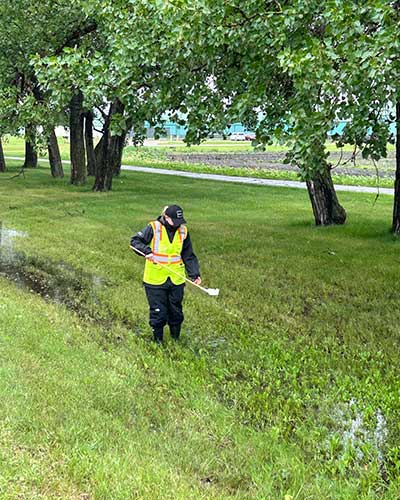
Crew member spraying for mosquitoes in a green space

What You Can Do

Protect Your Property

Mosquitoes develop in standing bodies of water. Ways to protect your yard:

  • Keep yards and eavestroughs clean
  • Remove standing water in intended places and look for other areas that standing water might accumulate such as in water barrels or old tires that may be left in yards
  • Cover rain barrels with a screen to keep raft laying species away
  • Change water in bird baths or ornamental ponds frequently to avoid giving mosquitoes the opportunity to develop
  • Ensure window and door screens fit tightly and are in good repair to prevent mosquitoes entering the home
  • Mow tall grass, weeds and underbrush to reduce shady resting sites for adult mosquitoes
  • Call 311 to report standing bodies of water in residential areas. City crews will inspect sites and treat if required.
  • Store pails, buckets and other equipment in such a way that they do not collect rainwater and organic material
  • Products such as mosquito coils, propane foggers, or spatial mosquito repellents should be used with caution, and as a last resort; they typically employ a cloud of insecticide, which may have impacts on other species, pets, or even human health.

Protect Yourself

  • Avoid outdoor activities at dawn and dusk when mosquitoes are most active
  • Apply insect repellent containing DEET
    • Adults: Concentrations up to 30% DEET are recommended
    • Children: Concentrations up to 10% of DEET suggested for children between 6 months to 12 years old; use mosquito netting for babies under 6 months old
  • Wear loose fitting, light coloured clothing. In areas with heavy populations of mosquitoes, wear high top boots and heavy material pants, shirts and jackets

Mosquito Species in Edmonton

Edmonton has over 30 species of mosquitoes, representing 6 groups. Only adult female mosquitoes bite, using blood as a source of protein for egg development. The most common mosquitoes in Edmonton belong to the Aedes and Ochlerotatus groups.

Aedes vexans lay eggs in dry or damp low-lying areas and hatch in the summer when water temperature exceeds 10°C. Heavy rainfall creates ideal conditions for this species, which can develop in 5 days and travel far distances. This species is the typical Edmonton summer nuisance mosquito, active mainly at dawn and dusk, and specializing in stealthy bites on large mammals, including humans. In the summer months this species makes up the majority of our mosquito population.

Adult Aedes vexans normally begin to appear in early to mid-May and last until the end of August.

Mosquitoes and West Nile Virus

High mosquito biting activity can make outdoor summer activities uncomfortable. There is also a possibility of getting West Nile virus (WNv).

WNv is an infection of birds that is spread to humans and other animals by a mosquito bite. Mosquitoes become carriers of this virus by taking a blood meal from an infected bird. 

Very few mosquitoes carry the virus in Edmonton.There is no evidence of people catching WNv from an infected person or animal through regular contact. Illness is more common in horses. Most people experience no symptoms or mild flu-like symptoms. In rare cases, the virus can cause severe illness.

WNv is primarily vectored by Culex pipiens, a relatively new species to the Edmonton area. Culex pipiens develops in container habitats such as rain barrels, bird baths, or stormwater catch basins, and their numbers are not as linked to rainfall as Aedes vexans.

For more information:

Alberta Health - West Nile Virus Surveillance
Health Canada - West Nile Virus
Centers for Disease Control & Prevention - About West Nile Virus

Mosquito Control History in Edmonton

default icon

2022

  • Transition to an entirely ground-based program. Aerial program using helicopters discontinued.
default icon

2020

  • First confirmed detection of the northern house mosquito (Culex pipiens), a common West Nile disease vector
  • Transition from New Jersey Light Traps to BG-Sentinel CO2 traps for mosquito activity monitoring
  • Fully implemented near real-time automated rain gauge network, replacing manual system
default icon

2018

  • Implemented GPS technology to track and report aerial and roadside applications; began development on GPS system to track granular backpack applications
  • Transition completely to a biorational pesticide program
  • Implemented UTVs (utility task vehicles) for off-road treatments
default icon

2012

  • Implemented mobile devices in the field to map standing water and collect larval mosquito development and population data in near real-time
default icon

2003

  • West Nile virus found in Alberta. The province initiated a three-year funding program for mosquito vector detection and source reduction.
default icon

1994

default icon

1993

default icon

1991

default icon

1980

default icon

1975

default icon

1973

default icon

1972

default icon

1953

Transforming Edmonton

Learn how the City is taking a bite out of mosquitoes.