

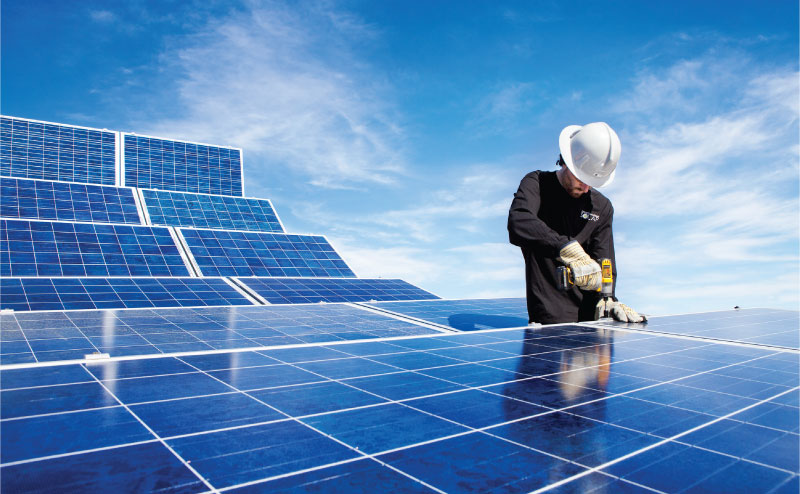
Renewable energy, such as solar and green power, can help reduce our greenhouse gas emissions while providing heat and power to our buildings
Learn about the many ways to generate power through renewable energy.
Solar Energy
Solar energy works in any climate and the fuel (sunshine) is free. Edmonton's winter climate is well-suited to solar energy. With 2,300 hours of sun in an average year, our city is one of the sunniest cities in Canada.
Solar Rebate Program
The City of Edmonton's residential solar rebate (for both single-family and multi-unit properties) has been fully subscribed and is no longer accepting applications.
Program Administrator: solar@edmonton.ca or 587-287-1903.
Green Energy Technology
Learn about some emerging technologies that have potential energy-related benefits.
Combined Heat and Power (CHP) or Cogeneration
A combined heat and power plant uses a fuel fired engine to generate power while simultaneously capturing the excess heat produced for heating purposes. Using the waste heat and creating electricity on-site makes the system more efficient than a traditional one fuelled by carbon intensive electricity.
These systems can require a lot of maintenance and are best suited for buildings which have a constant need for heat so that the excess heat is not wasted.
Furthermore, depending on the carbon emissions factor of your electricity grid, these systems can actually increase the carbon footprint, especially over time, as the electricity grid gets cleaner. Learn more about cogeneration.
District Energy
A district energy system is one that centralizes heating and cooling energy generation and distributes this energy to a larger area including many buildings, such as a neighbourhood. District energy systems traditionally use high-temperature boiler plants that distribute high-temperature water through insulated steel piping; this heat is then used directly at each building.
More recently, lower temperature systems are being used which allow much easier tie-in of renewable energy generation and eliminate the need for boiler plants.
An example is the ambient temperature district energy systems which extract low-grade heat from sewers or geo-exchange systems and deliver ambient temperature water to each building which can be used for heating or cooling. These systems are much more efficient and can share energy on a district scale.
Other Renewable Energy
Solar energy may be the best bet in Alberta, but there are other renewable energies that can be used here too.
Geo-exchange, Geothermal or Ground-Source Heat Pumps
Geothermal heating and cooling systems use buried pipes to take advantage of the stable earth temperature below the frost line. These systems extract or reject heat as needed using a heat pump (similar to an air conditioner or refrigerator). Geothermal systems don’t create heat (like a furnace does) but rather, they move heat and as a result, the efficiencies are much higher and can reduce heating and cooling consumption by 70 to 80% compared with traditional systems.
Even with a relatively carbon-intensive electricity grid, these systems provide carbon dioxide (CO2) emissions reduction, and when paired with green power, can eliminate carbon emissions entirely. While the initial cost can be high for a single-family home, the energy reduction is greater than with almost any other technology.
Hydrogen Fuel
Hydrogen is a clean energy source that, when used in a fuel cell, produces only water, electricity and heat. There are three different types of hydrogen:
- grey: uses fossil fuels and releases carbon dioxide
- blue: uses fossil fuels but captures and stores emitted carbon
- green: uses emission-free sources
While hydrogen would not be used at a household level, it can be an important piece in reducing our emissions at a larger level, such as industry, fleet and in communities. Visit Edmonton Region Hydrogen Hub to learn how hydrogen fits into our city's future.
Wind Energy
While large-scale wind energy generation sites are growing, small systems for homes tend to have relatively high costs compared to other options. It is worth noting that the winds Edmonton experiences are often intermittent and too variable in speed to generate significant quantities of electricity. As a result, it can be challenging to design a system to generate dependable power at the household level.
Contact Us
Environment and Climate Resilience
If you are calling from outside of Edmonton: 780-442-5311
Email changeforclimate@edmonton.ca
Phone 311